

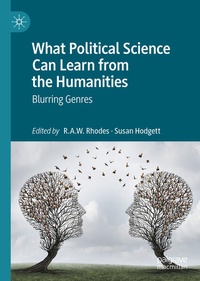
What Political Science Can Learn from the Humanities
Description
This book asks, 'what are the implications of blurring genres for the discipline of Political Science, and for Area Studies?' It argues novelists and playwrights provide a better guide for political scientists than the work of physicists. It restates the intrinsic value of the Humanities and Social Sciences and builds bridges between the two territories. The phrase blurring genres covers both genres of thought and of presentation. Genres of thought refers to such theoretical approaches as post structuralism, cultural studies, and especially interpretive thought. Part 1 explores genres of thought, focusing on the use of narratives. Specific examples include the narratives of post-truth political cultures; narratives in Canadian general elections; autoethnography as a new research tool; and novels as a way of understanding economic development. Part 2 emphasises genres of presentation and focuses on the visual arts. The chapters cover: photography in British political history, the architecture of American statehouses and city halls, design, comics, and using the creative arts to improve policy practice. This book is interdisciplinary and should have an appeal beyond political science to area studies specialists and others in the humanities. It is an advanced text, so it is aimed primarily at academics and postgraduates.
Reviews / Votes
"This book offers lots of surprises. Its chapters are deeply and rigorously grounded in several disciplines but the links across them are truly interdisciplinary. [It] offers an ambitious agenda of further scholarship in the burgeoning fields of narrative and linking humanities and social sciences. Some of these unconventional linkages (like autoethnography or architecture) challenge the reader. This insightful and thought provoking collection stimulates creative approaches to both political science and the humanities."- Mel Cappe , Professor at Munk School of Global Affairs and Public Policy, University of Toronto, Canada; and former Canadian Secretary to Cabinet and High Commissioner to the United Kingdom
"This admirable collection has long been needed. Dominated by its two editorial contributions, it takes with complete seriousness the long-needed admonition to teach the social sciences how to use to their advantage and imaginative transformation the methods, materials, and convictions of the humanities. The result is exhilarating and transformative."
- Fred Inglis , Emeritus Professor of Cultural Studies, University of Sheffield, UK.
"What Political Science Can Learn from the Humanities: Blurring Genres is an outstanding work of collaborative scholarship. The editors, Susan Hodgett and R. A. W. Rhodes, are prominent scholars who have assembled an all-star interdisciplinary team of contributors. This study applies analogies and metaphors from the humanities to political science and succeeds across the board. Blurring Genres sets an agenda for engagement of social sciences productively with the humanities that is based on disciplines ranging from architecture and design through comparative literature. The volume accesses a wide range of methods found in the humanities, such as autoethnography, along with content from fields like photography, to answer significant research questionswhile simultaneously identifying new and fascinating queries for further consideration. Blurring Genres is a volume that deserves attention throughout academia and even beyond because of its intellectual contributions and ability to inform our thinking about any number of social problems."
- Patrick James , Dornsife Dean's Professor of International Relations, University of Southern California
More details
Other editions
Additional editions
Persons
Susan Hodgett is the founding Professor of Area Studies at the University of East Anglia, UK. Her most recent book is Necessary Travel. New Area Studies and Canada in Comparative Perspective (edited with Patrick James, Lexington Books, 2018).