

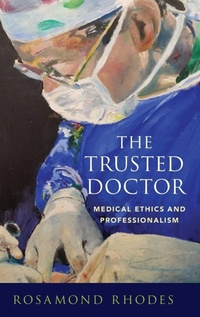
The Trusted Doctor
Medical Ethics and Professionalism
Published on 22. June 2020
Book
Hardback
432 pages
978-0-19-085990-9 (ISBN)
Description
Common morality has been the touchstone of medical ethics since the publication of Beauchamp and Childress's Principles of Biomedical Ethics in 1979. Rosamond Rhodes challenges this dominant view by presenting an original and novel account of the ethics of medicine, one deeply rooted in the actual experience of medical professionals. She argues that common morality accounts of medical ethics are unsuitable for the profession, and inadequate for responding to the particular issues that arise in medical practice. Instead, Rhodes argues that medicine's distinctive ethics should be explained in terms of the trust that society allows to the profession. Trust is the core and starting point of Rhodes' moral framework, which states that the most basic duty of doctors is to "seek trust and be trustworthy."
Building from this foundation, Rhodes explicates the sixteen specific duties that doctors take on when they join the profession, and demonstrates how her view of these duties is largely consistent with the codes of medical ethics of medical societies around the world. She then explains why it is critical for physicians to develop the attitudes or "doctorly" virtues that comprise the character of trustworthy doctors and buttress physicians' efforts to fulfil their professional obligations. Her book's presentation of physicians' duties and the elements that comprise a doctorly character, together add up to a cohesive and comprehensive description of what medical professionalism really entails. Rhodes's analysis provides a clear understanding of medical professionalism as well as a guide for doctors navigating the ethically challenging situations that arise in clinical practice
Building from this foundation, Rhodes explicates the sixteen specific duties that doctors take on when they join the profession, and demonstrates how her view of these duties is largely consistent with the codes of medical ethics of medical societies around the world. She then explains why it is critical for physicians to develop the attitudes or "doctorly" virtues that comprise the character of trustworthy doctors and buttress physicians' efforts to fulfil their professional obligations. Her book's presentation of physicians' duties and the elements that comprise a doctorly character, together add up to a cohesive and comprehensive description of what medical professionalism really entails. Rhodes's analysis provides a clear understanding of medical professionalism as well as a guide for doctors navigating the ethically challenging situations that arise in clinical practice
Reviews / Votes
Readers will appreciate the depth of reflection and insight that Rhodes brings with her from years of working at Mount Sanai. Rhodes' observations, especially regarding the special powers and privileges of medicine, provide a foundation for a fresh approach to medical ethics that takes seriously the distinctiveness of the profession. I hope that Rhodes' book sparks productive conversation in the field of bioethics for years to come. * Caitlin Maples, Theoretical Medicine and Bioethics * Rhodes's duties-first account is both persuasive and practical. It resets the conversation about the source and scope of medical ethics. Focusing on the duties of medical professionals does not prevent consideration of a range of examples beyond individual patient encounters that she connects to medical professional obligations * Elizabeth Lanphier, Hastings Center Report * Common morality has been the touchstone of medical ethics since the publication of Beauchamp and Childress's Principles of Biomedical Ethics in 1979. Rosamond Rhodes challenges this dominant view by presenting an original and novel account of the ethics of medicine, one deeply rooted in the actual experience of medical professionals...Trust is the core and starting point of Rhodes' moral framework, which states that the most basic duty of doctors is to "seek trust and be trustworthy." * Claire Clark, University of Kentucky's College of Medicine, New Books Network * Rhodes offers a powerful challenge to the field of bioethics to discard its long-standing approach to ethical problems in medicine of applying values drawn from common morality such as autonomy and beneficence to clinical matters. Instead, Rhodes argues compellingly, the ethics of medicine must be founded on the special powers, privileges, and immunities of medicine as a profession and the duty to exercise them in a manner that warrants patients' trust. * Leslie Francis, University of Utah *More details
Language
English
Place of publication
New York
United States
Target group
Professional and scholarly
Dimensions
Height: 240 mm
Width: 161 mm
Thickness: 27 mm
Weight
804 gr
ISBN-13
978-0-19-085990-9 (9780190859909)
Copyright in bibliographic data and cover images is held by Nielsen Book Services Limited or by the publishers or by their respective licensors: all rights reserved.
Schweitzer Classification
Other editions
Additional editions
E-Book
04/2020
OUP eBook
€49.99
Available for download
E-Book
04/2020
OUP eBook
€49.99
Available for download
Person
Rosamond Rhodes, Ph.D., is Professor of Medical Education and Director of Bioethics Education at Icahn School of Medicine at Mount Sinai, Professor of Philosophy at The Graduate Center, CUNY, and Professor of Bioethics and Associate Director of the Clarkson-Mount Sinai Bioethics Program. She writes on a broad array of issues in bioethics and has published more than 200 papers and chapters. She is co-editor of The Human Microbiome: Ethical, Legal and Social Concerns (Oxford University Press, 2013), The Blackwell Guide to Medical Ethics (Blackwell, 2007), Medicine and Social Justice: Essays on the Distribution of Health Care (Oxford University Press, first edition 2002; second edition 2012), and Physician Assisted Suicide: Expanding the Debate (Routledge, 1998).
Content
Dedication
Acknowledgments
Introduction
Chapter 1: Why a New Approach to Medical Ethics Is Needed
Chapter 2: The Distinctive Ethics of Medicine
Chapter 3: Medicine's Core Responsibilities
Chapter 4: The Commitment to Science
Chapter 5: Behavior toward Patients
Chapter 6: Autonomy and Trust
Chapter 7: The Commitment to Truth
Chapter 8: Physicians' Commitments to Fellow Professionals
Chapter 9: The Commitment to Justice
Chapter 10: Additional Professional Virtues
Chapter 11: Resolving Ethical Dilemmas
Chapter 12: Why the Best Interest Standard Is Not Good
Chapter 13: Professional Responsibility and Claims of Conscientious Objection
Chapter 14: Concluding Thoughts
Appendix
Acknowledgments
Introduction
Chapter 1: Why a New Approach to Medical Ethics Is Needed
Chapter 2: The Distinctive Ethics of Medicine
Chapter 3: Medicine's Core Responsibilities
Chapter 4: The Commitment to Science
Chapter 5: Behavior toward Patients
Chapter 6: Autonomy and Trust
Chapter 7: The Commitment to Truth
Chapter 8: Physicians' Commitments to Fellow Professionals
Chapter 9: The Commitment to Justice
Chapter 10: Additional Professional Virtues
Chapter 11: Resolving Ethical Dilemmas
Chapter 12: Why the Best Interest Standard Is Not Good
Chapter 13: Professional Responsibility and Claims of Conscientious Objection
Chapter 14: Concluding Thoughts
Appendix