

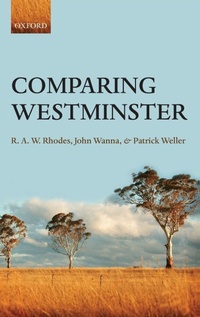
Comparing Westminster
Published on 27. August 2009
Book
Hardback
276 pages
978-0-19-956349-4 (ISBN)
Description
This book explores how the governmental elites in Australia, Britain, Canada, New Zealand, and South Africa understand their Westminster system. It examines in detail four interrelated features of Westminster systems. Firstly, the increasing centralisation in collective, responsible cabinet government. Second, the constitutional convention of ministerial and collective responsibility. Third, the role of a professional, non-partisan public service. And finally, parliament's relationship to the executive. The authors explain the changes that have occured in the Westminster model by analysing four traditions: royal prerogative, responsible government, constitutional bureaucracy, and representative government. They suggest that each tradition has a recurring dilemma, between centralisation and decentralisation, party government and ministerial responsibility, professionalisation and politicisation, and finally elitism and participation. They go on to argue that these dilemmas recur in four present-day debates: the growth of prime ministerial power, the decline in individual and collective ministerial accountability, politicisation of the public service, and executive dominance of the legislature. They conclude by identifying five meanings of - or narratives about - Westminster. Firstly, 'Westminster as heritage' - elite actors' shared governmental narrative understood as both precedents and nostalgia. Second, 'Westminster as political tool' - the expedient cloak worn by governments and politicians to defend themselves and criticise opponents. Third, 'Westminster as legitimising tradition' - providing legitimacy and a context for elite actions, serving as a point of reference to navigate this uncertain world. Fourth, 'Westminster as institutional category' - it remains a useful descriptor of a loose family of governments with shared origins and characteristics. Finally, 'Westminster as an effective political system' - it is a more effective and efficient political system than consensual parliamentary governments. Westminster is a flexible family of ideas that is useful for many purposes and survives, even thrives, because of its meaning in use to elite actors.
Reviews / Votes
an exceptionally intelligent book which brings to subject of political institutions subtleties of interpretation which only sound scholarship allows. * Arthur Aughey, Parliamentary Affairs * full of interesting insights and stories, and is rich in detail of the operation of the political system in the chosen countries. The way in which politicians appeal to the term Westminster is revealing. * Eoin OMalley, Political Studies Review * Rhodes, Wanna and Weller...are interested in taking a new approach to the comparative study of a well-known family of political systems, which breaks from previous staid approaches. In doing so, the authors have at the very least provided an up to date discussion of how Westminster core executives currently operate, and succeeded in making Westminster interested again. * Ben Yong, UCL, Public Law Journal *More details
Language
English
Place of publication
Oxford
United Kingdom
Target group
College/higher education
Dimensions
Height: 240 mm
Width: 161 mm
Thickness: 19 mm
Weight
581 gr
ISBN-13
978-0-19-956349-4 (9780199563494)
Copyright in bibliographic data and cover images is held by Nielsen Book Services Limited or by the publishers or by their respective licensors: all rights reserved.
Schweitzer Classification
Other editions
Additional editions
R. A.W. Rhodes | John Wanna | Patrick Weller
Comparing Westminster
Book
07/2011
Oxford University Press
€68.20
Shipment within 15-20 days
Persons
Rod Rhodes
2004 to date, Treasurer and Secretary, Australasian Political Studies Association
2005 for life, Vice-President of the Political Studies Association of the United Kingdom. Previously Chair (1999-2002) and President (2002-2005).
2004 to date, Fellow of the Academy of Social Sciences in Australia.
2002 to date, Academician of the Academy of Social Sciences (UK).
1999-2002, Member of the Executive Committee of the International Political Science Association.
1986-2011, Editor, Public Administration.
John Wanna
2006 to date, Fellow of the Institute of Public Administration, Australia
2006 to date, Fellow of the Academy of Social Sciences, Australia
2002, President of Australian Political Studies Association
1995 to date, Member of National Council, Institute of Public Administration, Australia
1995, Editor of Australian Journal of Public Administration.
Patrick Weller
2006 Adjunct Professor, Australian and New Zealand School of Government
2002 Appointed an Officer of the Order of Australia in June 2002 for 'service through research in political science and public administration and for extending knowledge of executive government'.
1996 Fellow of the Academy of Social Sciences in Australia.
1995 Honorary Life Member, Australasian Political Studies Association
2004 to date, Treasurer and Secretary, Australasian Political Studies Association
2005 for life, Vice-President of the Political Studies Association of the United Kingdom. Previously Chair (1999-2002) and President (2002-2005).
2004 to date, Fellow of the Academy of Social Sciences in Australia.
2002 to date, Academician of the Academy of Social Sciences (UK).
1999-2002, Member of the Executive Committee of the International Political Science Association.
1986-2011, Editor, Public Administration.
John Wanna
2006 to date, Fellow of the Institute of Public Administration, Australia
2006 to date, Fellow of the Academy of Social Sciences, Australia
2002, President of Australian Political Studies Association
1995 to date, Member of National Council, Institute of Public Administration, Australia
1995, Editor of Australian Journal of Public Administration.
Patrick Weller
2006 Adjunct Professor, Australian and New Zealand School of Government
2002 Appointed an Officer of the Order of Australia in June 2002 for 'service through research in political science and public administration and for extending knowledge of executive government'.
1996 Fellow of the Academy of Social Sciences in Australia.
1995 Honorary Life Member, Australasian Political Studies Association
Author
Professor of Government, University of Tasmania
Sir John Bunting Professor of Politics and Public Administration, Research School of Social Sciences, Australian National University and Professor in Public Policy, Griffith University
Professor of Politics and Public Policy, Premier of Queensland Chair of Governance and Public Policy, Griffith University.
Content
Preface and Acknowledgements ; List of Tables ; List of Abbreviations ; 1. Looking for Westminster ; 2. Comparing Westminster ; 3. Living Traditions ; 4. Executive and Cabinet ; 5. Ministerial Responsibility ; 6. The Public Service ; 7. Parliaments and Representation ; 8. The Meanings of Westminster ; Bibliography ; Index