

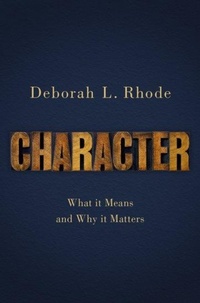
Character
What it Means and Why it Matters
Published on 9. October 2019
Book
Hardback
336 pages
978-0-19-091987-0 (ISBN)
Description
Americans claim to care about character. Over four fifths want it taught in public schools, and 95 percent think that a president's character is important. And historically, philosophers, educators, politicians, religious leaders, judges, and the general public have agreed that character should be valued and reinforced. Yet in the United States, the institutions charged with that mission have consistently fallen short. Simply put, too little effort has been made to understand the importance of character and the strategies that can best develop and support it.
After first exploring the history of the concept over time, Deborah Rhode turns her focus to the institutions that have traditionally fostered good character: families, schools, youth organizations, civic groups, and political organizations. However, as we have increasingly de-emphasized the subject-a trend that is most evident in our politics-our awareness of its shaping influence has waned. Indeed, we often focus on the wrong things when it comes to fostering good character. For instance, almost a third of the workforce is covered by licensing laws requiring good moral character, even occupations where the need for screening is not self-evident: florist, fortune teller, and frog farmers. Character also plays a pivotal role in the criminal justice system, in defining guilt, punishment, and eligibility for parole. All too often, these legal requirements are idiosyncratic, inequitable, and subject to race and class bias. Millions of Americans who have convictions for minor offenses are excluded from a vast range of occupations and benefits without evidence that such exclusion serves the public interest. We can do better, she stresses, and outlines a powerful program for reform.
Rhode punctuates the book through a series of portraits of exemplary individuals whose good character made them who they were: Ida B. Wells, Jane Addams, Martin Luther King, Mother Teresa, Nelson Mandela, Albert Schweitzer, and Thurgood Marshall. All of these individuals had flaws, but through their commitments to both social justice and helping the less fortunate, they all demonstrate the power and importance of strong character.
After first exploring the history of the concept over time, Deborah Rhode turns her focus to the institutions that have traditionally fostered good character: families, schools, youth organizations, civic groups, and political organizations. However, as we have increasingly de-emphasized the subject-a trend that is most evident in our politics-our awareness of its shaping influence has waned. Indeed, we often focus on the wrong things when it comes to fostering good character. For instance, almost a third of the workforce is covered by licensing laws requiring good moral character, even occupations where the need for screening is not self-evident: florist, fortune teller, and frog farmers. Character also plays a pivotal role in the criminal justice system, in defining guilt, punishment, and eligibility for parole. All too often, these legal requirements are idiosyncratic, inequitable, and subject to race and class bias. Millions of Americans who have convictions for minor offenses are excluded from a vast range of occupations and benefits without evidence that such exclusion serves the public interest. We can do better, she stresses, and outlines a powerful program for reform.
Rhode punctuates the book through a series of portraits of exemplary individuals whose good character made them who they were: Ida B. Wells, Jane Addams, Martin Luther King, Mother Teresa, Nelson Mandela, Albert Schweitzer, and Thurgood Marshall. All of these individuals had flaws, but through their commitments to both social justice and helping the less fortunate, they all demonstrate the power and importance of strong character.
Reviews / Votes
... the book is well-researched and supported by scientific studies, which lends credibility to Rhode's conclusions ... she presents readers with several ways in which character affects legal and political decisions that people may not routinely consider. Overall, I would recommend this book to anyone who is interested in why character matters in modern American society, and especially to those with professional interests in law, politics and justice. * Jennifer Kamorowski, AC Review of Books *More details
Language
English
Place of publication
New York
United States
Product notice
sewn/stitched
Cloth over boards
Dimensions
Height: 236 mm
Width: 157 mm
Thickness: 30 mm
Weight
590 gr
ISBN-13
978-0-19-091987-0 (9780190919870)
Copyright in bibliographic data and cover images is held by Nielsen Book Services Limited or by the publishers or by their respective licensors: all rights reserved.
Schweitzer Classification
Other editions
Person
Deborah L. Rhode is the Ernest W. McFarland Professor of Law, and the director of the Center on the Legal Profession at Stanford University. She was the founding president of the International Association of Legal Ethics, the former president of the Association of American Law Schools, and the former founding director of Stanford's Center on Ethics. She is the nation's most frequently cited scholar on legal ethics and the author of 30 books in the fields of professional responsibility, leadership, and gender.
Content
Chapter 1 What is Character
Chapter 2 Character Development
Chapter 3 Character in Law
Chapter 4 Character in Criminal Justice
Chapter 5 Character in Politics
Chapter 6 Profiles in Character: Lives of Service
Chapter 7 Profiles in Character: The Pursuit of Social Justice
Chapter 8 Conclusion
Chapter 2 Character Development
Chapter 3 Character in Law
Chapter 4 Character in Criminal Justice
Chapter 5 Character in Politics
Chapter 6 Profiles in Character: Lives of Service
Chapter 7 Profiles in Character: The Pursuit of Social Justice
Chapter 8 Conclusion