

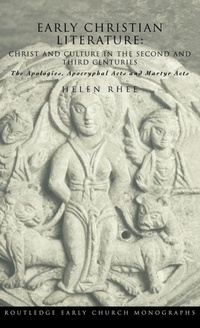
Early Christian Literature
Christ and Culture in the Second and Third Centuries
1st Edition
Published on 29. April 2005
Book
Hardback
240 pages
978-0-415-35487-5 (ISBN)
Description
Helen Rhee's outstanding work is the first book to bring together The Apologies and the semi-fictional Apocryphal Acts and Martyr Acts in a single study. Filling a significant gap in the scholarship, she looks at Christian self definition and self representation in the context of pagan-Christian conflict.
Using an interdisciplinary approach; historical, literary, theological, sociological, and anthropological, Rhee studies the Christians in the formative period of their religion; from mid first to early third centuries. She examines how the forms of Greco-Roman society were adapted by the Christians to present the superiority of Christian monotheism, Christian sexual morality, and Christian (dis)loyalty to the Empire.
Tackling broad topics, including theology, asceticism, sexuality and patriotism, this book explores issues of cultural identity and examines how these propagandist writings shaped the theological, moral and political trajectories of Christian faith and contributed largely to the definition of orthodoxy.
This thorough study will benefit all students of early Christianity and Greco-Roman literary culture and civilization.
Using an interdisciplinary approach; historical, literary, theological, sociological, and anthropological, Rhee studies the Christians in the formative period of their religion; from mid first to early third centuries. She examines how the forms of Greco-Roman society were adapted by the Christians to present the superiority of Christian monotheism, Christian sexual morality, and Christian (dis)loyalty to the Empire.
Tackling broad topics, including theology, asceticism, sexuality and patriotism, this book explores issues of cultural identity and examines how these propagandist writings shaped the theological, moral and political trajectories of Christian faith and contributed largely to the definition of orthodoxy.
This thorough study will benefit all students of early Christianity and Greco-Roman literary culture and civilization.
More details
Series
Language
English
Place of publication
London
United Kingdom
Publishing group
Taylor & Francis Ltd
Target group
College/higher education
Postgraduate
Dimensions
Height: 222 mm
Width: 145 mm
Thickness: 20 mm
Weight
535 gr
ISBN-13
978-0-415-35487-5 (9780415354875)
Copyright in bibliographic data and cover images is held by Nielsen Book Services Limited or by the publishers or by their respective licensors: all rights reserved.
Schweitzer Classification
Other editions
Additional editions
E-Book
04/2005
Routledge
€73.99
Available for download
E-Book
04/2005
Routledge
€73.99
Available for download
Book
04/2005
1st Edition
Routledge
€79.30
Shipment within 15-20 days
Person
Rhee, Helen
Content
Abbreviations Introduction 1. Second Century Literature in Its Historical-Cultural Context Christianity in the mid-second and the early third centuries Christian interaction with Greco-Roman society Literature of the second century: the Apologies, Apocryphal Acts and Martyr Acts Triangular relationship 2. Superiority of Christian Monotheism Apologies: Christianity as true philosophy Apocryphal Acts: Christianity as true power Martyr Acts: Christianity as true piety Summary and Conclusion 3. Superiority of Christian Sexual Morality Asceticism in general: the controlling paradigm Asceticism: sexual chastity and renunciation Chastity, marriage and family in Greco-Roman society Marriage and celibacy in the New Testament Apologies: harmony with the established social order Tatian and enratism Apocryphal Acts: antithesis of the social ideal and resistance to the social order Martyr Acts: renunciation of social mores Summary and Conclusion 4. Christian Loyalty to the Empire Imperial cult: unity of religion and politics Apologies: Christian loyalty to the Empire Apocryphal Acts: Christian subversiveness to the Empire Martyr Acts: Christian resistance to the Empire Summary and Conclusion Conclusion Bibliography Index