

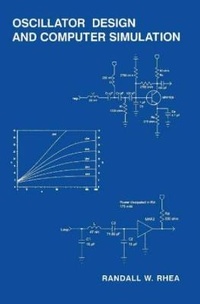
Oscillator Design and Computer Simulation
2nd Edition
Published on 30. June 1995
Book
Hardback
320 pages
978-1-884932-30-4 (ISBN)
Description
This second edition of the number one guide to oscillator design presents a comprehensive, unified approach to oscillator design that can be used with a wide range of active devices and resonator types. Resonator types covered include: L-C, crystal, SAW, dielectric resonator, coaxial line, stripline and microstrip. This text covers modern CAD synthesis and analysis techniques and is valuable to experienced engineers as well as to those new to oscillator design. The books topics include: Analysis fundamentals, oscillator fundamentals, limiting and starting, biasing, noise, computer simulation and examples and case studies.
More details
Series
Edition
2nd edition
Language
English
Place of publication
New York
United States
Target group
College/higher education
Professional and scholarly
Dimensions
Height: 229 mm
Width: 152 mm
ISBN-13
978-1-884932-30-4 (9781884932304)
Copyright in bibliographic data and cover images is held by Nielsen Book Services Limited or by the publishers or by their respective licensors: all rights reserved.
Schweitzer Classification
Other editions
Additional editions
Randall W. Rhea
Oscillator Design and Computer Simulation
E-Book
05/2014
2nd Edition
SciTech Publishing Inc
€134.69
Available for download
Person
Randall W. Rhea is the founder of Eagleware Corporation, which specializes in developing and marketing fast, easy and affordable RF and microwave design software. In the course of more than 30 years of experience in RF design, he has held engineering positions with Scientific Atlanta, Inc., the Boeing Company and Goodyear Aerospace. Mr Rhea is also the author of HF Filter Design and Computer Simulation.
Content
Chapter 1: Analysis Fundamentals
Chapter 2: Oscillator Fundamentals
Chapter 3: Limiting and Starting
Chapter 4: Noise
Chapter 5: Biasing
Chapter 6: Computer Techniques
Chapter 7: Circuits
Chapter 8: L-C Oscillators
Chapter 9: Distributed Oscillators
Chapter 10: SAW Oscillators
Chapter 11: Quartz Crystal Oscillators
Chapter 12: Case Studies
Chapter 2: Oscillator Fundamentals
Chapter 3: Limiting and Starting
Chapter 4: Noise
Chapter 5: Biasing
Chapter 6: Computer Techniques
Chapter 7: Circuits
Chapter 8: L-C Oscillators
Chapter 9: Distributed Oscillators
Chapter 10: SAW Oscillators
Chapter 11: Quartz Crystal Oscillators
Chapter 12: Case Studies