

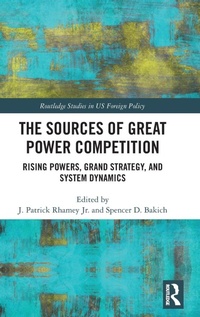
The Sources of Great Power Competition
Rising Powers, Grand Strategy, and System Dynamics
1st Edition
Published on 25. October 2024
Book
Hardback
318 pages
978-1-032-49996-3 (ISBN)
Description
This volume explores the determinants of state power, the strategic options of rising powers, the drivers of conflict in dynamic international systems, and American grand strategy past and present to achieve a more comprehensive understanding of the current era of great power competition.
Leveraging insights from international relations, history, economics, and political demography, it offers rich perspectives on the competition among newly rising powers and long-dominant leaders in the international system. This book presents novel theories and innovative empirical investigations into the economic and demographic challenges confronting rising powers, along with new inquiries into these countries' capacity to mobilize both their citizens and their militaries. While China's grand strategy has attracted significant attention in recent years, these authors look beyond U.S.-PRC relations by considering the war proneness and strategic repertoires of rising regional powers, including India and Russia. Yet, the possibility of great power war remains a justifiable concern. This book examines the so-called Thucydides's Trap by exploring both its explanatory power in the conflict that inspired its name, the Peloponnesian War, and the possible mechanisms for averting war between the two most powerful countries in the current era. Finally, several challenges confronting the United States are discussed, including climate change, competition over the interpretation of the international Women, Peace, and Security agenda, and the durability of America's commitment to upholding the liberal international order.
The Sources of Great Power Competition brings together many of the most influential scholars to engage in lively debates about the current and future international system. It will be of interest to foreign policy practitioners and scholars of grand strategy, the causes of war, alliance politics, norms and narratives in foreign policy, power transitions, and international hierarchy.
Leveraging insights from international relations, history, economics, and political demography, it offers rich perspectives on the competition among newly rising powers and long-dominant leaders in the international system. This book presents novel theories and innovative empirical investigations into the economic and demographic challenges confronting rising powers, along with new inquiries into these countries' capacity to mobilize both their citizens and their militaries. While China's grand strategy has attracted significant attention in recent years, these authors look beyond U.S.-PRC relations by considering the war proneness and strategic repertoires of rising regional powers, including India and Russia. Yet, the possibility of great power war remains a justifiable concern. This book examines the so-called Thucydides's Trap by exploring both its explanatory power in the conflict that inspired its name, the Peloponnesian War, and the possible mechanisms for averting war between the two most powerful countries in the current era. Finally, several challenges confronting the United States are discussed, including climate change, competition over the interpretation of the international Women, Peace, and Security agenda, and the durability of America's commitment to upholding the liberal international order.
The Sources of Great Power Competition brings together many of the most influential scholars to engage in lively debates about the current and future international system. It will be of interest to foreign policy practitioners and scholars of grand strategy, the causes of war, alliance politics, norms and narratives in foreign policy, power transitions, and international hierarchy.
More details
Series
Language
English
Place of publication
London
United Kingdom
Publishing group
Taylor & Francis Ltd
Target group
College/higher education
Professional and scholarly
Postgraduate and Undergraduate Advanced
Illustrations
43 s/w Abbildungen, 43 s/w Zeichnungen, 17 s/w Tabellen
17 Tables, black and white; 43 Line drawings, black and white; 43 Illustrations, black and white
Dimensions
Height: 240 mm
Width: 161 mm
Thickness: 23 mm
Weight
672 gr
ISBN-13
978-1-032-49996-3 (9781032499963)
Copyright in bibliographic data and cover images is held by Nielsen Book Services Limited or by the publishers or by their respective licensors: all rights reserved.
Schweitzer Classification
Other editions
Additional editions
J. Patrick Rhamey Jr. | Spencer D. Bakich
The Sources of Great Power Competition
Rising Powers, Grand Strategy, and System Dynamics
Book
05/2026
1st Edition
Routledge
€57.00
Shipment within 10-20 days
J. Patrick Rhamey Jr. | Spencer D. Bakich
The Sources of Great Power Competition
Rising Powers, Grand Strategy, and System Dynamics
E-Book
10/2024
1st Edition
Routledge
€60.49
Available for download
J. Patrick Rhamey Jr. | Spencer D. Bakich
The Sources of Great Power Competition
Rising Powers, Grand Strategy, and System Dynamics
E-Book
10/2024
1st Edition
Routledge
€60.49
Available for download
Persons
J. Patrick Rhamey Jr. is a Professor of International Studies and Political Science at the Virginia Military Institute, USA and Board Member of the TransResearch Consortium. His research includes the impact of systemic hierarchy on international order, the causes of international conflict, and theorizing in the subfield of comparative regionalism. He is the author of Power, Space, and Time: An Empirical Introduction to International Relations, a textbook intended to introduce undergraduates to data-driven international relations approaches with an emphasis on hierarchy as an ordering principle.
Spencer D. Bakich is a Professor of International Studies and Political Science, Director of the National Security Program at the Virginia Military Institute, USA, and Senior Fellow at the Miller Center at the University of Virginia. He is the author of The Gulf War: George H. W. Bush and American Grand Strategy in the Post-Cold War Era and Success and Failure in Limited War: Information and Strategy in the Korean, Vietnam, Persian Gulf, and Iraq Wars.
Spencer D. Bakich is a Professor of International Studies and Political Science, Director of the National Security Program at the Virginia Military Institute, USA, and Senior Fellow at the Miller Center at the University of Virginia. He is the author of The Gulf War: George H. W. Bush and American Grand Strategy in the Post-Cold War Era and Success and Failure in Limited War: Information and Strategy in the Korean, Vietnam, Persian Gulf, and Iraq Wars.
Content
Introduction: System Complexity and Strategic Narratives in the Era of Great Power
Competition
Spencer D. Bakich
Part I: The Determinants of State Power
Chapter 1: "Rising Powers" in International Politics: Which Powers are Rising and Are They
Challengers to the Liberal World Order?
Thomas J. Volgy and Kelly Marie Gordell
Chapter 2: India and China: Population Futures
Tadeusz Kugler and Kristina Khederlarian Fightmaster
Chapter 3: "Patriots" with Different Characteristics: A Typology of Motives in the Chinese Anti- Japan Protests in 2012
Ketian Zhang
Chapter 4: Bvt. Major General Emory Upton's Military Policy of the United States and the
Origins of U.S. Army Reform in the Late Nineteenth Century
Barton A. Myers
Part II: Diplomatic Strategies of Rising Powers
Chapter 5: Stepping Into and Out of the Hegemon's Shadow: Exploring the Alignment Decisions
of Rising Regional Powers
Evan Braden Montgomery
Chapter 6: Russia: From Superpower to Second-Tier State
Jacek Kugler, Ronald L. Tammen, and Yuzhu Zeng
Chapter 7: Cooperation Between India and the BRICS: A Challenge to the Global Liberal Order
Aakriti A. Tandon and Michael O. Slobodchikoff
Part III: Rising Powers and International Conflict
Chapter 8: Rising Power Fallacies in the Etiology of Interstate War
William R. Thompson
Chapter 9: Avoiding Thucydides's Trap with China as a Rising Power: Causal depth, Critical
Neoclassical Realism, U.S. Grand Strategy and Global Order
Haider A. Khan
Chapter 10: What Thucydides Trap? Power, Threat, and the Great War that Ripped through
Classical Greece
Scott A. Silverstone
Chapter 11: Strategic Narratives and U.S. Grand Strategy Toward Rising Powers
C. William Walldorf, Jr.
Part IV: America's Response to Rising Powers
Chapter 12: Sustainable Strategic Adjustment: Confronting Climate Change and Rethinking
Restraint in U.S. Grand Strategy
Jonathan M. DiCicco and Fahad Rajput
Chapter 13: Major Power Contestation and the Instrumentalization of Women, Peace, and
Security
Alexis Henshaw
Chapter 14: Should I Stay or Should I Go? How China's Rise Affects America's Commitment to the Liberal International Order
Kyle M. Lascurettes
Chapter 15: Power Shift, Problem Shift, and Policy Shift: Reacting to China's Rise
Steve Chan
Conclusion: A Grand Strategy of Satisfaction
J. Patrick Rhamey Jr.
Competition
Spencer D. Bakich
Part I: The Determinants of State Power
Chapter 1: "Rising Powers" in International Politics: Which Powers are Rising and Are They
Challengers to the Liberal World Order?
Thomas J. Volgy and Kelly Marie Gordell
Chapter 2: India and China: Population Futures
Tadeusz Kugler and Kristina Khederlarian Fightmaster
Chapter 3: "Patriots" with Different Characteristics: A Typology of Motives in the Chinese Anti- Japan Protests in 2012
Ketian Zhang
Chapter 4: Bvt. Major General Emory Upton's Military Policy of the United States and the
Origins of U.S. Army Reform in the Late Nineteenth Century
Barton A. Myers
Part II: Diplomatic Strategies of Rising Powers
Chapter 5: Stepping Into and Out of the Hegemon's Shadow: Exploring the Alignment Decisions
of Rising Regional Powers
Evan Braden Montgomery
Chapter 6: Russia: From Superpower to Second-Tier State
Jacek Kugler, Ronald L. Tammen, and Yuzhu Zeng
Chapter 7: Cooperation Between India and the BRICS: A Challenge to the Global Liberal Order
Aakriti A. Tandon and Michael O. Slobodchikoff
Part III: Rising Powers and International Conflict
Chapter 8: Rising Power Fallacies in the Etiology of Interstate War
William R. Thompson
Chapter 9: Avoiding Thucydides's Trap with China as a Rising Power: Causal depth, Critical
Neoclassical Realism, U.S. Grand Strategy and Global Order
Haider A. Khan
Chapter 10: What Thucydides Trap? Power, Threat, and the Great War that Ripped through
Classical Greece
Scott A. Silverstone
Chapter 11: Strategic Narratives and U.S. Grand Strategy Toward Rising Powers
C. William Walldorf, Jr.
Part IV: America's Response to Rising Powers
Chapter 12: Sustainable Strategic Adjustment: Confronting Climate Change and Rethinking
Restraint in U.S. Grand Strategy
Jonathan M. DiCicco and Fahad Rajput
Chapter 13: Major Power Contestation and the Instrumentalization of Women, Peace, and
Security
Alexis Henshaw
Chapter 14: Should I Stay or Should I Go? How China's Rise Affects America's Commitment to the Liberal International Order
Kyle M. Lascurettes
Chapter 15: Power Shift, Problem Shift, and Policy Shift: Reacting to China's Rise
Steve Chan
Conclusion: A Grand Strategy of Satisfaction
J. Patrick Rhamey Jr.