

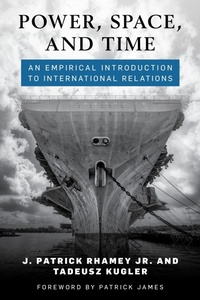
Power, Space, and Time
An Empirical Introduction to International Relations
Will be published approx. on 24. January 2020
Book
Paperback/Softback
304 pages
978-1-5381-2723-0 (ISBN)
Description
Undergraduate students in most preliminary courses in international politics are introduced to realist, liberal, and constructivist approaches, supplementing this theoretical introduction with conceptual discussions of the state, international system, and/or decision-making and policy formation. By the end of their college experience, undergraduate IR majors will engage coursework more narrowly focused on an empirical outcome, such as war, economic integration, development, or migration. These advanced courses are directly linked to modern research agendas and graduate level course material, usually with few references to the theoretical paradigms taught in introductory classes. This volume seeks to bridge the gap between what is taught in early undergraduate education and what is created by scholars, uniting abstract theoretical principles with practical contemporary policy and testable empirical questions.
Reviews / Votes
Power, Space, and Time is a unique combination of textbook and secondary resource. Rhamey (Virginia Military Institute) and Kugler (Roger Williams Univ.) shed light on important concepts and apply them to the evolving international relations of the 21st century. The authors divide the discussion into three parts-"Conflict," "Cooperation," "Key Issues Confronting the Twenty-First Century"-each with four succinct chapters. In the first sections, they analyze and illustrate the nature of conflict and cooperation and provide discussion questions and elaborate on key terms. This analysis provides the basis for the last section, which concludes with a chapter titled "American Decline, Chinese Rise, and an Unexpected Future." This volume also includes a glossary, a 20-page notes section, and a thorough bibliography. Summing Up: Recommended. Upper-division undergraduates through faculty. * Choice Reviews * This is a book that takes seriously the idea that anarchy and hierarchy coexist in world politics. It offers both theory and case material to help readers comprehend the balance between the two main concepts as played out in world politics. -- Patrick James, University of Southern California Rhamey and Kugler apply a unifying theoretical lens (about hierarchy in world politics) to motivate discussions of international conflict, international cooperation, and future challenges and past lessons. They knit together what we know about the structure of the international system and the sources of power within states to present arguments about a wide range of IR activity. An excellent book for an upper-level IR theory course. -- Douglas Lemke, Pennsylvania State UniversityMore details
Language
English
Place of publication
United States
Publishing group
Bloomsbury Publishing Plc
Target group
College/higher education
US School Grade: From College Freshman to College Graduate Student
Product notice
Paperback (trade)
Unsewn / adhesive bound
Illustrations
8 tables; 11 charts; 10 textboxes
Dimensions
Height: 226 mm
Width: 153 mm
Thickness: 17 mm
Weight
372 gr
ISBN-13
978-1-5381-2723-0 (9781538127230)
Copyright in bibliographic data and cover images is held by Nielsen Book Services Limited or by the publishers or by their respective licensors: all rights reserved.
Schweitzer Classification
Other editions
Additional editions
J. Patrick Rhamey Jr. | Tadeusz Kugler
Power, Space, and Time
An Empirical Introduction to International Relations
E-Book
01/2020
1st Edition
Rowman & Littlefield Publishers
€32.99
Available for download
J. Patrick Rhamey Jr. | Tadeusz Kugler
Power, Space, and Time
An Empirical Introduction to International Relations
E-Book
01/2020
1st Edition
Rowman & Littlefield Publishers
€32.99
Available for download
Persons
J. Patrick Rhamey, Jr. is Associate Professor in the Department of International Studies and Political Science at the Virginia Military Institute. His publications include work on the behaviours of major and regional powers, comparative regionalism, and the international politics of sport.
Tadeusz "Tad" Kugler is an Associate Professor of Political Science at Roger Williams University. He received his Ph.D. in Economics and Politics at Claremont Graduate University. His publications focus on the economic and demographic foundations of growth and their connection to international power and the dynamics of recovery after war.
Tadeusz "Tad" Kugler is an Associate Professor of Political Science at Roger Williams University. He received his Ph.D. in Economics and Politics at Claremont Graduate University. His publications focus on the economic and demographic foundations of growth and their connection to international power and the dynamics of recovery after war.
Content
List of Figures
List of Tables
Foreword
Preface
About the Authors
Chapter 1 A Hierarchical Approach
Chapter 2 Concepts and Measures
Part 1: Conflict
Chapter 3 International Conflict
Chapter 4 Rivalries and Alliances
Chapter 5 Intrastate Conflicts
Chapter 6 The Cold War
Part 2: Cooperation
Chapter 7 Organizational Formation & Evolution
Chapter 8 Regionalization and Trade
Chapter 9 Development and Globalization
Chapter 10 Contemporary Regional Orders in the American Imperium
Part 3: Key Issues Confronting the 21st Century
Chapter 11 Deterrence and the Potential for Great-Power War
Chapter 12 Liberalism and the Democratic Peace
Chapter 13 Lessons for the American Imperium in the Decline of the British Empire
Chapter 14 American Decline, Chinese Rise, and the Unexpected Future
Glossary
Bibliography
Index
List of Tables
Foreword
Preface
About the Authors
Chapter 1 A Hierarchical Approach
Chapter 2 Concepts and Measures
Part 1: Conflict
Chapter 3 International Conflict
Chapter 4 Rivalries and Alliances
Chapter 5 Intrastate Conflicts
Chapter 6 The Cold War
Part 2: Cooperation
Chapter 7 Organizational Formation & Evolution
Chapter 8 Regionalization and Trade
Chapter 9 Development and Globalization
Chapter 10 Contemporary Regional Orders in the American Imperium
Part 3: Key Issues Confronting the 21st Century
Chapter 11 Deterrence and the Potential for Great-Power War
Chapter 12 Liberalism and the Democratic Peace
Chapter 13 Lessons for the American Imperium in the Decline of the British Empire
Chapter 14 American Decline, Chinese Rise, and the Unexpected Future
Glossary
Bibliography
Index