

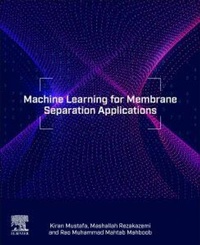
Machine Learning for Membrane Separation Applications
Published on 25. September 2025
Book
Paperback/Softback
272 pages
978-0-443-27422-0 (ISBN)
Description
Machine Learning for Membrane Separation Applications covers the importance of polymeric membranes in separation processes and explains how machine learning is taking these processes to the next level. As polymeric membranes can be used for both gas and liquid separations, along with several other applications, they provide a bypass route to separation due to several fold benefits over traditional techniques. Sections cover the role of Machine Learning in membranes design and development, fouling mitigation, and filtration systems. Machine Learning in a wide variety of polymeric membranes, such as nanocomposite membranes, MOF based membranes, and disinfecting membranes are also covered.
This book will serve as a useful tool for researchers in academia and industry, but will also be an ideal reference for students and teachers in membrane science and technology who are looking for new ways to develop state-of-the-art membranes and membrane technologies for liquid and gas separations, such as wastewater treatment and CO2 mitigation.
This book will serve as a useful tool for researchers in academia and industry, but will also be an ideal reference for students and teachers in membrane science and technology who are looking for new ways to develop state-of-the-art membranes and membrane technologies for liquid and gas separations, such as wastewater treatment and CO2 mitigation.
More details
Language
English
Place of publication
Philadelphia
United States
Target group
Professional and scholarly
Product notice
Paperback (trade)
Unsewn / adhesive bound
Dimensions
Height: 234 mm
Width: 190 mm
Thickness: 16 mm
Weight
522 gr
ISBN-13
978-0-443-27422-0 (9780443274220)
Copyright in bibliographic data and cover images is held by Nielsen Book Services Limited or by the publishers or by their respective licensors: all rights reserved.
Schweitzer Classification
Other editions
Additional editions
Mashallah Rezakazemi | Kiran Mustafa | Rao Muhammad Mahtab Mahboob
Machine Learning for Membrane Separation Applications
E-Book
09/2025
Elsevier
€214.99
Available for download
Persons
Dr. Mashallah Rezakazemi received his BEng. and MEng. degrees in 2009 and 2011, respectively, both in Chemical Engineering, from the Iran University of Science and Technology (IUST), and his Ph.D. from the University of Tehran (UT) in 2015. Dr. Rezakazemi's research is in the general area of the Membrane Technology, Adsorption, Environmental Science to the service of the broad areas of learning and training. Specifically, his research in engineered and natural environmental systems involves: (i) membrane-based processes for energy-efficient desalination, CO2 capture, gas separation, and wastewater reuse, (ii) sustainable production of enriched gas stream, water and energy generation with the engineered membrane, (iii) environmental applications and implications of nanomaterials, and (iv) water and sanitation in developing countries.
He has coauthored in more than 190 highly cited journal publications, conference articles and book chapters. He has received major awards (x16) and grants (x12) from various funding agencies in recognition of his research. He was awarded as country's best researcher in technical and engineering group, Ministry of Science, Research and Technology, Iran.
Rezakazemi published Wiley's book "Membrane Contactor Technology: Water Treatment, Food Processing, Gas Separation, and Carbon Capture?. Dr. Kiran Mustafa earned her doctorate from The Women University Multan and currently serves as a Chemistry Lecturer in the Higher Education Department, Punjab, Pakistan. During her doctoral studies, she conducted research on polymeric membranes for water treatment with desalination, degradation, and disinfection properties. She has a profound interest in research and publishing, having published a book titled "Nanotechnology and Generation of Sustainable Hydrogen" with Springer, as well as numerous journal articles and 10 book chapters.
Rao Muhammad Mahtab Mahboob is a Software Engineer with expertise in data science. He is currently serving as a Lecturer in the University College of Management and Sciences Khanewal, Pakistan. His masters research involved predictive analysis and data mining. His areas of interests include Machine Learning, Big Data and Bioinformatics. He had researched and published articles on artificial intelligence and wastewater treatment, component-based development, concurrency control techniques, machine learning algorithms in breast cancer prognosis, security concerns of IoT in healthcare and benefits of Big Data in healthcare.
He has coauthored in more than 190 highly cited journal publications, conference articles and book chapters. He has received major awards (x16) and grants (x12) from various funding agencies in recognition of his research. He was awarded as country's best researcher in technical and engineering group, Ministry of Science, Research and Technology, Iran.
Rezakazemi published Wiley's book "Membrane Contactor Technology: Water Treatment, Food Processing, Gas Separation, and Carbon Capture?. Dr. Kiran Mustafa earned her doctorate from The Women University Multan and currently serves as a Chemistry Lecturer in the Higher Education Department, Punjab, Pakistan. During her doctoral studies, she conducted research on polymeric membranes for water treatment with desalination, degradation, and disinfection properties. She has a profound interest in research and publishing, having published a book titled "Nanotechnology and Generation of Sustainable Hydrogen" with Springer, as well as numerous journal articles and 10 book chapters.
Rao Muhammad Mahtab Mahboob is a Software Engineer with expertise in data science. He is currently serving as a Lecturer in the University College of Management and Sciences Khanewal, Pakistan. His masters research involved predictive analysis and data mining. His areas of interests include Machine Learning, Big Data and Bioinformatics. He had researched and published articles on artificial intelligence and wastewater treatment, component-based development, concurrency control techniques, machine learning algorithms in breast cancer prognosis, security concerns of IoT in healthcare and benefits of Big Data in healthcare.
Content
1. Introduction to Membrane Technology and Machine Learning
2. Understanding Machine Learning Fundamentals: Membrane Insights
3. Machine learning Applications in Membrane Fabrication Techniques
4. Machine Learning Applications in Membrane Characterization Techniques
5. Molecular Dynamics Simulations in Membrane Separations
6. Machine Learning in Gas Separation Applications
7. Machine Learning in Modern Membrane Water Treatment Systems
8. Machine learning in Membrane Fouling and Aging Predictions
9. Machine Learning and Its Impact on Advanced Membrane Materials
10. Challenges, Opportunities, and Future of ML in Membrane Technology
2. Understanding Machine Learning Fundamentals: Membrane Insights
3. Machine learning Applications in Membrane Fabrication Techniques
4. Machine Learning Applications in Membrane Characterization Techniques
5. Molecular Dynamics Simulations in Membrane Separations
6. Machine Learning in Gas Separation Applications
7. Machine Learning in Modern Membrane Water Treatment Systems
8. Machine learning in Membrane Fouling and Aging Predictions
9. Machine Learning and Its Impact on Advanced Membrane Materials
10. Challenges, Opportunities, and Future of ML in Membrane Technology