

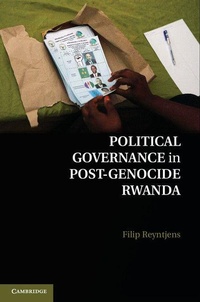
Political Governance in Post-Genocide Rwanda
Published on 30. December 2013
Book
Hardback
315 pages
978-1-107-04355-8 (ISBN)
Description
Filip Reyntjens's book analyzes political governance in post-genocide Rwanda and focuses on the rise of the authoritarian Rwandan Patriotic Front (RPF). In the aftermath of the 1994 Rwandan genocide, the RPF has employed various means - rigged elections, elimination of opposition parties and civil society, legislation outlawing dissenting opinions, and terrorism - to consolidate power and perpetuate its position as the nation's ruling party. Although many international observers have hailed Rwanda as a 'success story' for its technocratic governance, societal reforms, and economic development, Reyntjens complicates this picture by casting light on the regime's human rights abuses, social engineering projects, information management schemes, and retributive justice system.
More details
Language
English
Place of publication
Cambridge
United Kingdom
Target group
Professional and scholarly
College/higher education
Dimensions
Height: 235 mm
Width: 157 mm
Thickness: 22 mm
Weight
616 gr
ISBN-13
978-1-107-04355-8 (9781107043558)
Copyright in bibliographic data and cover images is held by Nielsen Book Services Limited or by the publishers or by their respective licensors: all rights reserved.
Schweitzer Classification
Other editions
Additional editions
Filip Reyntjens
Political Governance in Post-Genocide Rwanda
Book
06/2015
Cambridge University Press
€39.90
Shipment within 15-20 days
Filip Reyntjens
Political Governance in Post-Genocide Rwanda
E-Book
12/2013
Cambridge University Press
€21.99
Available for download
Filip Reyntjens
Political Governance in Post-Genocide Rwanda
E-Book
10/2013
1st Edition
Cambridge University Press
€23.49
Available for download
Person
Filip Reyntjens is Professor of African Law and Politics at the Institute of Development Policy and Management, University of Antwerp.
Content
Introduction; 1. The capture of power and the path to hegemony; 2. Elections as a means of regime consolidation; 3. Managing political space; 4. Human rights, a dismal record; 5. Dealing with the world and the region; 6. Engineering a new society; 7. Managing information, imposing the truth; 8. The politics of justice; Conclusion.