

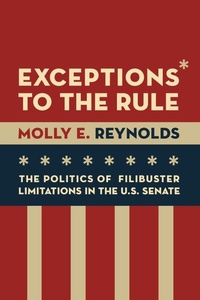
Exceptions to the Rule
The Politics of Filibuster Limitations in the U.S. Senate
Published on 18. July 2017
Book
Paperback/Softback
290 pages
978-0-8157-2996-9 (ISBN)
Description
Special rules enable the Senate to act despite the filibuster. Sometimes.
Most people believe that, in today's partisan environment, the filibuster prevents the Senate from acting on all but the least controversial matters. But this is not exactly correct. In fact, the Senate since the 1970s has created a series of special rules?described by Molly Reynolds as ?majoritarian exceptions"?that limit debate on a wide range of measures on the Senate floor.
The details of these exemptions might sound arcane and technical, but in practice they have enabled the Senate to act even when it otherwise seemed paralyzed. Important examples include procedures used to pass the annual congressional budget resolution, enact budget reconciliation bills, review proposals to close military bases, attempt to prevent arms sales, ratify trade agreements, and reconsider regulations promulgated by the executive branch.
Reynolds argues that these procedures represent a key instrument of majority party power in the Senate. They allow the majority?even if it does not have the sixty votes needed to block a filibuster?to produce policies that will improve its future electoral prospects, and thus increase the chances it remains the majority party.
As a case study, Exceptions to the Rule examines the Senate's role in the budget reconciliation process, in which particular congressional committees are charged with developing procedurally protected proposals to alter certain federal programs in their jurisdictions. Created as a way of helping Congress work through tricky budget issues, the reconciliation process has become a powerful tool for the majority party to bypass the minority and adopt policy changes in hopes that it will benefit in the next election cycle.
Most people believe that, in today's partisan environment, the filibuster prevents the Senate from acting on all but the least controversial matters. But this is not exactly correct. In fact, the Senate since the 1970s has created a series of special rules?described by Molly Reynolds as ?majoritarian exceptions"?that limit debate on a wide range of measures on the Senate floor.
The details of these exemptions might sound arcane and technical, but in practice they have enabled the Senate to act even when it otherwise seemed paralyzed. Important examples include procedures used to pass the annual congressional budget resolution, enact budget reconciliation bills, review proposals to close military bases, attempt to prevent arms sales, ratify trade agreements, and reconsider regulations promulgated by the executive branch.
Reynolds argues that these procedures represent a key instrument of majority party power in the Senate. They allow the majority?even if it does not have the sixty votes needed to block a filibuster?to produce policies that will improve its future electoral prospects, and thus increase the chances it remains the majority party.
As a case study, Exceptions to the Rule examines the Senate's role in the budget reconciliation process, in which particular congressional committees are charged with developing procedurally protected proposals to alter certain federal programs in their jurisdictions. Created as a way of helping Congress work through tricky budget issues, the reconciliation process has become a powerful tool for the majority party to bypass the minority and adopt policy changes in hopes that it will benefit in the next election cycle.
Reviews / Votes
Exceptions to the Rule should be required reading for anyone concerned about the state of the Senate today. Reynolds' in-depth analysis of majoritarian exceptions offers valuable insight into a subset of parliamentary procedures that will be sure to dominate Senate decision-making for years to come."- James Wallner, LegBranch.org;"Reynolds' book is a must-read for any student of Congress and is an indispensable resource for understanding the reconciliation process and its role in the contemporary Senate. The book is eminently readable and should be included on syllabi for graduate-level courses and undergraduate senior seminars on Congress. Majoritarian exceptions are enormously important to understanding the dynamics of major policy change at the federal level today, and Reynolds has given us an exceptional piece of scholarship on the topic."- Gregory Wowro, Congress & the Presidency;
"Focusing on the budget reconciliation process, Reynolds brings to light the ways by which majorities can enact legislation, ratify agreements, and alter executive regulations. Recommended for legislative scholars and those wishing to gain a better understanding of how laws are made in the US Congress. Recommended."- CHOICE;
"This is an extraordinarily well-written and exceptionally thorough book that promises to shift our understanding of Senate legislating in important ways. Some treatments of congressional procedure can be dry and cumbersome, but not this one! This book offers important contributions to the study of the Senate, by pushing the scholarly literature to more seriously consider the mechanisms that reduce the thresholds for successful legislating. . . . Exceptions to the Rule is a must-read for any student or interested observer of congressional politics."- Ryan J. Vander Wielen, American Review of Politics
More details
Language
English
Place of publication
United States
Publishing group
Bloomsbury Publishing Plc
Target group
Professional and scholarly
Illustrations
25 Tables
Dimensions
Height: 229 mm
Width: 152 mm
Thickness: 17 mm
Weight
474 gr
ISBN-13
978-0-8157-2996-9 (9780815729969)
Copyright in bibliographic data and cover images is held by Nielsen Book Services Limited or by the publishers or by their respective licensors: all rights reserved.
Schweitzer Classification
Other editions
Additional editions
E-Book
07/2017
1st Edition
Brookings Institution
€28.49
Available for download
E-Book
07/2017
1st Edition
Brookings Institution
€28.49
Available for download
Person
Molly E. Reynolds is a fellow in Governance Studies at the Brookings Institution, where she studies Congress, with an emphasis on the policy consequences of congressional rules and procedures.
Content
Contents:
Introduction
Limiting the Unlimited: Debate in the U.S. Senate
Obscuring the Causal Chain: Majoritarian Exceptions as a Blame Avoidance Tool
Employing the Exceptions: The Case of Budget Reconciliation
The Policy Consequences of Procedural Choice: Programmatic Change Using Budget Reconciliation
Facilitating Gain and Blocking Pain: Creating Executive Branch Oversight Exceptions
Conclusion
Appendix Tables
Notes
Works Cited
Acknowledgments
Index
Introduction
Limiting the Unlimited: Debate in the U.S. Senate
Obscuring the Causal Chain: Majoritarian Exceptions as a Blame Avoidance Tool
Employing the Exceptions: The Case of Budget Reconciliation
The Policy Consequences of Procedural Choice: Programmatic Change Using Budget Reconciliation
Facilitating Gain and Blocking Pain: Creating Executive Branch Oversight Exceptions
Conclusion
Appendix Tables
Notes
Works Cited
Acknowledgments
Index