

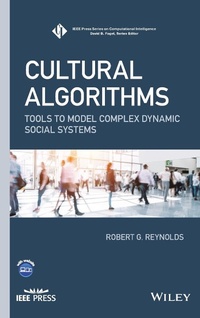
Cultural Algorithms: Tools to Model Complex Dynamic Social Systems
Tools to Model Complex Dynamic Social Systems
1st Edition
Published on 12. August 2020
Book
Hardback
288 pages
978-1-119-40308-1 (ISBN)
Description
A thorough look at how societies can use cultural algorithms to understand human social evolution
For those working in computational intelligence, developing an understanding of how cultural algorithms and social intelligence form the essential framework for the evolution of human social interaction is essential. This book, Cultural Algorithms: Tools to Model Complex Dynamic Social Systems, is the foundation of that study. It showcases how we can use cultural algorithms to organize social structures and develop socio-political systems that work.
For such a vast topic, the text covers everything from the history of the development of cultural algorithms and the basic framework with which it was organized. Readers will also learn how other nature-inspired algorithms can be expressed and how to use social metrics to assess the performance of various algorithms.
In addition to these topics, the book covers topics including:
* The CAT system including the Repast Simphony System and CAT Sample Runs
* How to problem solve using social networks in cultural algorithms with auctions
* Understanding Common Value Action to enhance Social Knowledge Distribution Systems
* Case studies on team formations
* An exploration of virtual worlds using cultural algorithms
For industry professionals or new students, Cultural Algorithms provides an impactful and thorough look at both social intelligence and how human social evolution translates into the modern world.
More details
Other editions
Additional editions
E-Book
12/2020
1st Edition
Wiley
€120.99
Available for download
E-Book
11/2020
1st Edition
Wiley
€120.99
Available for download
Person
Dr. Robert G. Reynolds is a Professor of Computer Science at Wayne State University and a Visiting Associate Research Scientist at the University of Michigan's Museum of Anthropology. In addition to serving as the Computational Intelligence Representative to the IEEE USA Research and Development Committee, he is also an Associate Editor for eight IEEE journals.
Content
1. System Design Using Cultural Algorithms
Introduction
The Cultural Engine
Outline of the Book: Cultural Learning in Dynamic Environments
2. The Cultural Algorithms Toolkit
Cultural Algorithms Toolkit Overview
Downloading and Running CAT
The Repast Simphony System
Knowledge Sources
Fitness Functions
Conesworld
The Logistics Function
Cultural Algorithms Toolkit Sample Runs: Conesworld
Cultural Algorithms Toolkit Sample Runs: Other Problems
3. Problem Solving Using Social Networks in Cultural Algorithms with Auctions
Introduction
Cultural Algorithms
Subcultured Heterogeneous Networks
Auction Mechanisms
The Cultural Engine
Cones World
Experimental Framework
Results
Conclusions
References
4. Using Common Value Auction In Cultural Algorithm to Enhance Robustness and Resilience of Social Knowledge Distribution Systems
Cultural Algorithms
Common Value Auction
Cones World
Dynamic Experimental Framework
Results
Conclusions and Future Work
5. Optimizing AI Pipelines: A Game-Theoretic Cultural Algorithms Approach
Introduction
Overview of Cultural Algorithms
Cultural Algorithms Knowledge Distribution Mechanisms
Primer on Game Theory
Game Theoretic Knowledge Distribution
Continuous-Action Iterated Prisoner's Dilemma
Play
Payoff
Outcome
Learning Rate Adjustment
Test Results: Benchmark Problem
Test Results: Computer Vision Pipeline
Conclusions
6. Cultural Algorithms for Social Network Analysis - Case Studies in Team Formation
Introduction
Application of Social Network
Forming Successful Teams
Formulating TFP
Communication Cost
Personnel Cost
Distance Cost
Workload Balance
Why Artificial Intelligence?
Cultural Algorithms
Forming Teams in Co-authorship Network
Individual Representation
Fitness Function
Belief Space
Dataset and Observations
Skill Frequency
Forming Teams in Healthcare Network
Individual Representation
Fitness Function
Dataset and Observation
Summary and Conclusion
7. Evolving Emergent Team Strategies in Robotic Soccer using Enhanced Cultural Algorithms
Abstract
Introduction
Related Work
The 2D Soccer Simulation Testbed
Evolution of team strategies via Cultural Algorithm
Experiments and Analysis of Results
Conclusion
References
8. The Use of Cultural Algorithms to Learn the Impact of Climate on Local Fishing Behavior in Cerro Azul, Peru
Introduction
An Overview of the Cerro Azul Fishing Data Set
Data Mining at the Macro, Meso, and Micro Levels
Cultural Algorithms and Multi-Objective Optimization
The Artisanal Fishing Model
The Experimental Results
Statistical Validation
Conclusions and Future Work
9. CAPSO: A Parallelized Multiobjective Cultural Algorithm Particle Swarm Optimizer
Introduction
Multi-Objective Optimization
Cultural Algorithms
CAPSO Knowledge Structures
Tracking Knowledge Source Progress (Other than Topographic)
CAPSO Algorithm Pseudocode
Multiple Runs
Benchmark Problems Comparison
Overall Summary of Results
Other Applications
10. Exploring Virtual Worlds with Cultural Algorithms: Ancient Alpena-Amberley Land Bridge
Archaeological Challenges
Generalized Framework
The Land Bridge Hypothesis
Origin and Form
Putting Data to Work
Path-Finding and Planning
Identifying Good Locations
Cultural Algorithms
Cultural Algorithm Mechanisms
The Composition of the Belief Space
Future Work
Path Planning Strategy
Local Tactics
Detailed Locational Information
Extending the Cultural Algorithms
Human Presence in the Virtual World
Increasing the Complexity
Updated Path-Planning Results
The Fully Rendered Land Bridge
Pathfinder Mechanisms
Results
Conclusions