

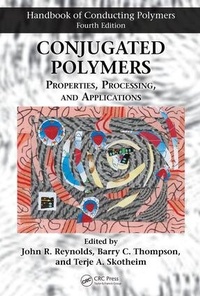
Conjugated Polymers
Properties, Processing, and Applications
4th Edition
Published on 3. April 2019
Book
Hardback
828 pages
978-1-138-06570-3 (ISBN)
Description
The Fourth Edition of the Handbook of Conducting Polymers, Two-Volume Set continues to be the definitive resource on the topic of conducting polymers. Completely updated with an extensive list of authors that draws on past and new contributors, the book takes into account the significant developments both in fundamental understanding and applications since publication of the previous edition.
One of two volumes comprising the comprehensive Handbook, Conjugated Polymers: Properties, Processing, and Applications features new chapters focusing on these topics within conducting polymers. It discusses properties and characterization, including thermoelectric and mechanical properties, as well as processing and morphology, covering such topics as thermal phase behavior influence on optoelectronic properties, effect of miscibility on organic solar cells, and more. Finally, the book discusses applications, including the use of conducting polymers in stretchable electronics, electrochemical capacitors, and biomedical applications.
Aimed at researchers, advanced students, and industry professionals working in materials science and engineering, this book covers properties, processing, characterization, and morphology in a wide-ranging listing of comprehensive chapters authored by an international team of experts.
One of two volumes comprising the comprehensive Handbook, Conjugated Polymers: Properties, Processing, and Applications features new chapters focusing on these topics within conducting polymers. It discusses properties and characterization, including thermoelectric and mechanical properties, as well as processing and morphology, covering such topics as thermal phase behavior influence on optoelectronic properties, effect of miscibility on organic solar cells, and more. Finally, the book discusses applications, including the use of conducting polymers in stretchable electronics, electrochemical capacitors, and biomedical applications.
Aimed at researchers, advanced students, and industry professionals working in materials science and engineering, this book covers properties, processing, characterization, and morphology in a wide-ranging listing of comprehensive chapters authored by an international team of experts.
Reviews / Votes
"It can be concluded that this 4th edition of this handbook fulfills its intention, to be the definitive resource on the topic of conducting polymers. This is assured by the updated and added contributions of all authors, which take into account the significant developments both in fundamental understanding and applications since publication of the previous edition. So, it can be recommended to everyone who wants to get a comprehensive overview on conjugated polymers, not just to researchers, advanced students, and industry professionals working in materials science and engineering."-- Journal of Materials and Corrosion, Ralph Baessler, 2019
More details
Series
Edition
4th edition
Language
English
Place of publication
London
United Kingdom
Publishing group
Taylor & Francis Ltd
Target group
Professional and scholarly
Illustrations
363 s/w Abbildungen, 56 farbige Abbildungen, 23 s/w Tabellen
23 Tables, black and white; 56 Illustrations, color; 363 Illustrations, black and white
Dimensions
Height: 254 mm
Width: 178 mm
Weight
1882 gr
ISBN-13
978-1-138-06570-3 (9781138065703)
Copyright in bibliographic data and cover images is held by Nielsen Book Services Limited or by the publishers or by their respective licensors: all rights reserved.
Schweitzer Classification
Other editions
Additional editions
John R. Reynolds | Barry C. Thompson | Terje A. Skotheim
Conjugated Polymers
Properties, Processing, and Applications
E-Book
03/2019
4th Edition
CRC Press
€265.99
Available for download
John R. Reynolds | Barry C. Thompson | Terje A. Skotheim
Conjugated Polymers
Properties, Processing, and Applications
E-Book
03/2019
4th Edition
CRC Press
€265.99
Available for download
Previous edition
Book
12/2006
3rd Edition
CRC Press
€245.53
Article exhausted; check for reprint
Persons
Terje A. Skotheim is the founder of Lightsense and has a successful record in developing new technologies and launching new products in fields as diverse as advanced lithium-sulfur batteries, MEMS devices, photovoltaic cells, and biosensors, through several startups. His research interests have spanned across several disciplines in materials science, including conducting polymers, semiconductors, ion conductors and diamond-like carbon. He has held research positions and co-founded companies in Europe and the US, and was head of the conducting polymer group at DOE's Brookhaven National Laboratory before launching his career as an entrepreneur. He received his B.S. in physics from the Massachusetts Institute Technology and his Ph.D. in physics from the University of California at Berkeley.
John R. Reynolds, a native Californian, obtained his B.S. in Chemistry at San Jose State University (1979) followed by his M.S. (1982) and Ph.D. (1984) in Polymer Science and Engineering at the University of Massachusetts. He became interested in the field of conducting and electroactive polymers through a position with the IBM Research Laboratories in the late 1970s. After developing his own research effort at The University of Texas at Arlington (1984-1991), he moved to the University of Florida where he was a Professor of Chemistry and Associate Director of the Center for Macromolecular Science and Engineering until Spring 2012, when his group moved to Georgia Tech where he is a Professor of Chemistry and Biochemistry, and Materials Science and Engineering. He serves as Director of the Georgia Tech Polymer Network (GTPN) and is a member of the Center for Organic Photonics and Electronics (COPE) management team.
Barry C. Thompson was born in Milwaukee, Wisconsin in 1977 and moved to Gallipolis, Ohio at a young age, where he attended elementary and high school. Barry then attended the University of Rio Grande in Rio Grande, Ohio, where he majored in Chemistry and Physics and minored in Mathematics. After completing his undergraduate studies at Rio Grande, Barry moved to the University of Florida to pursue a Ph.D. in Chemistry with Prof. John R. Reynolds as an NSF Graduate Research Fellow. During his Ph.D. studies, Barry focused on the design and synthesis of electroactive conjugated polymers for electrochromic and photovoltaic applications. Upon completion of his Ph.D. in 2005, Barry moved to Prof. Jean Frechet's lab at UC Berkeley to further pursue his interests in polymer-based photovoltaics as an ACS-PRF Postdoctoral Fellow. After a three-year stay at Berkeley, Barry moved to the University of Southern California, Department of Chemistry and Loker Hydrocarbon Research Institute as an Assistant Professor of Chemistry. Barry was promoted to Associate Professor with Tenure in 2015.
John R. Reynolds, a native Californian, obtained his B.S. in Chemistry at San Jose State University (1979) followed by his M.S. (1982) and Ph.D. (1984) in Polymer Science and Engineering at the University of Massachusetts. He became interested in the field of conducting and electroactive polymers through a position with the IBM Research Laboratories in the late 1970s. After developing his own research effort at The University of Texas at Arlington (1984-1991), he moved to the University of Florida where he was a Professor of Chemistry and Associate Director of the Center for Macromolecular Science and Engineering until Spring 2012, when his group moved to Georgia Tech where he is a Professor of Chemistry and Biochemistry, and Materials Science and Engineering. He serves as Director of the Georgia Tech Polymer Network (GTPN) and is a member of the Center for Organic Photonics and Electronics (COPE) management team.
Barry C. Thompson was born in Milwaukee, Wisconsin in 1977 and moved to Gallipolis, Ohio at a young age, where he attended elementary and high school. Barry then attended the University of Rio Grande in Rio Grande, Ohio, where he majored in Chemistry and Physics and minored in Mathematics. After completing his undergraduate studies at Rio Grande, Barry moved to the University of Florida to pursue a Ph.D. in Chemistry with Prof. John R. Reynolds as an NSF Graduate Research Fellow. During his Ph.D. studies, Barry focused on the design and synthesis of electroactive conjugated polymers for electrochromic and photovoltaic applications. Upon completion of his Ph.D. in 2005, Barry moved to Prof. Jean Frechet's lab at UC Berkeley to further pursue his interests in polymer-based photovoltaics as an ACS-PRF Postdoctoral Fellow. After a three-year stay at Berkeley, Barry moved to the University of Southern California, Department of Chemistry and Loker Hydrocarbon Research Institute as an Assistant Professor of Chemistry. Barry was promoted to Associate Professor with Tenure in 2015.
Content
Properties and Characterization of Conjugated Polymers. Photophysics. Conducting Polymers. Transport in Conjugated Polymers. Thermoelectrics. Electrochemistry of Conducting Polymers. Electrochromic Polymers. Mechanical Properties of Conjugated Polymers. Photorefractive Polymers. Optoelectronic Polymers. Processing and Morphology of Conjugated Polymers. Printing. Thermal Processing. Morphology Evolution. Conducting Polymer Composites. Oligomer Based Film Structure. Thin Film Structure. Soft X-ray Structural Characterization (RoXS). OFET Applications. Polymers for Organic Photovoltaics. Organic Photovoltaics Architecture. Organic Photovoltaics. Applications of Conjugated Polymers. Conjugated Polymer Sensors. Electrochromic Polymer Devices. Electronic Skin. Electrochemical Devices. Bio- Applications. Redox Active Polymers. Supercapacitors. Actuators and Artificial Muscles. Industrial Status of PEDVT. Aerospace Applications.