

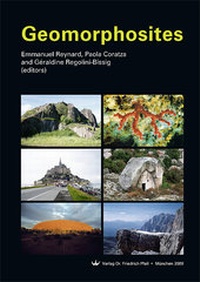
Geomorphosites
1st Edition
Published on 15. May 2009
Book
Paperback/Softback
240 pages
978-3-89937-094-2 (ISBN)
Description
Geoheritage - that are the geological and geomorphological elements of nature worthy of being conserved - is an important component of the natural heritage. In most cases, it constitutes the skeleton of the landscape. The new interest of the scientific community for the geomorphological heritage - the so-called geomorphosites - has induced the International Association of Geomorphologists (IAG) to create in September 2001, at the 5th International Conference on Geomorphology held in Tokyo, a specific working group aiming to improve knowledge and scientific research on the definition, assessment, cartography, promotion and conservation of geomorphosites.
More details
Persons
Content
ANDREW GOUDIE, President International Association of Geomorphologists: Foreword 4
MARIO PANIZZA, Former President International Association of Geomorphologists: Préface 4
EMMANUEL REYNARD, PAOLA CORATZA and GÉRALDINE REGOLINI-BISSIG: Scientific research on geomorphosites over the last eight years: improvements and aims of the book 5-8
Section I - What are geomorphosites?
1. EMMANUEL REYNARD: Geomorphosites: definitions and characteristics 9-20
2. EMMANUEL REYNARD: Geomorphosites and landscapes 21-34
3. MARIO PANIZZA and SANDRA PIACENTE: Cultural geomorphology and geodiversity 35-48
4. ENRIQUE SERRANO and PURIFICACIÓN RUIZ-FLAÑO: Geomorphosites and geodiversity 49-61
Section II - Assessment and mapping
5. EMMANUEL REYNARD: The assessment of geomorphosites 63-71
6. VIOLA MARIA BRUSCHI and ANTONIO CENDRERO: Direct and parametric methods for the assessment of geosites and geomorphosites 73-88
7. PAOLA CORATZA and GÉRALDINE REGOLINI-BISSIG: Methods for mapping geomorphosites 89-103
Section III - Protection and promotion
8. NICKOLAS ZOUROS: Geomorphosites within geoparks 105-118
9. PIOTR MIGON: Geomorphosites and the World Heritage List of UNESCO 119-130
10. MANUELA PELFINI, PIERLUIGI BRANDOLINI, ALBERTO CARTON and MAURO PICCAZZO: Geotourist trails: a geomorphological risk-impact analysis 131-143
11. BERNARD J. SMITH, JULIAN D. ORFORD and NICHOLAS L. BETTS: Management challenges of a dynamic geomorphosite: climate change and the Giant's Causeway World Heritage Site 145-162
Section IV - Examples of geomorphosite management
12. IRASEMA ALCÁNTARA-AYALA: Geomorphosite management in areas sensitive to natural hazards 163-173
13. BERNIE JOYCE: Geomorphosites and volcanism 175-188
14. FABIEN HOBLÉA: Karstic geomorphosites: managing subterranean natural-cultural heritage sites 189-200
15. PAOLO ORRÙ and MARIO PANIZZA: Assessment and management of submerged geomorphosites. A case study in Sardinia (Italy) 201-212
16. ERIC FOUACHE and MICHEL RASSE: Archaeology, geoarchaeology and geomorphosite management: towards a typology of geoarchaeosites 213-223
17. RICHARD PRIKRYL: Geomorphosites and quarries 225-233
EMMANUEL REYNARD: Perspectives for geomorphosite studies 235-237
Authors 238-250
Foreword
The International Association of Geomorphologists (IAG), which was officially founded in 1989, holds its sixth International Conference in Melbourne, Australia, in July 2009. It has three objectives under its constitution: to develop geomorphology through international co-operation; to promote the study and development of geomorphology in all aspects; and to foster the dissemination of knowledge of geomorphology. One of the ways that the IAG fulfils these objectives is to nurture various working groups. One of these, the working group on "Geomorphosites", was established at the IAG International Conference at Chuo University in Tokyo in 2001 and has been remarkably active since that time. It provides a fine example of international collaboration. Moreover, geomorphosites are an important way in which to disseminate knowledge about, and appreciation of, landforms and geomorphology. Many geomorphologists take up their discipline because of their exposure at an early age to beautiful and intriguing landscapes. In addition, although they may never have heard the term "geomorphology", many members of the general public derive tremendous pleasure and profit from visiting major landform sites. It is important that we explain and conserve such sites, and manage them properly. This volume, written by a first class international team, will help in this endeavour.
ANDREW GOUDIE
University of Oxford
President of the IAG, 2005-2009
Préface
Le Groupe de travail sur les Géomorphosites a été institué en 2001 à Tokyo à l'occasion de la Cinquième Conférence Internationale de Géomorphologie, au début de ma période présidentielle (2001-2005).
Depuis, de multiples réunions internationales de ce groupe de travail ont été organisées, souvent plus d'une par année et dans différents pays européens et extra-européens. Ces rencontres ont bénéficié de la contribution de nombreux chercheurs qui mènent des études sur les thèmes de la reconnaissance et de la valorisation du patrimoine géologique, en particulier du patrimoine géomorphologique.
Ce livre a pour objectif de rassembler et faire le point sur les connaissances les plus récentes sur le thème des géomorphosites, soit en parcourant le développement de leur définition, de leur représentation cartographique et de leur valorisation culturelle, soit en présentant des exemples significatifs de protection et de valorisation dans différents contextes géographiques et scientifiques.
L'Association italienne ' Geologia e Turismo ' (G&T), à laquelle appartiennent les auteurs de certains chapitres, est heureuse de contribuer financièrement à la publication de cet ouvrage. G&T a pour objectif principal la valorisation du patrimoine géologique et l'intégration de cette composante du paysage dans les politiques de promotion du tourisme culturel.
L'intérêt toujours plus important de l'opinion publique et les nouvelles opportunités professionnelles qui s'ouvrent aux jeunes diplômés, tant au niveau local que national, encouragent le développement de la recherche dans ce secteur. Il faut ainsi espérer que le groupe de travail sur les Géomorphosites soit renouvelé à l'occasion de la prochaine Conférence Internationale de Géomorphologie qui se tiendra à Melbourne en juillet 2009, afin de maintenir l'importante fonction internationale qu'il a acquise. Je remercie en particulier Emmanuel Reynard qui a, pendant 8 ans, guidé et stimulé avec compétence et passion les activités du Groupe de travail.
MARIO PANIZZA
Président de l'Association italienne ' Geologia e Turismo '
Ancien président de l'Association Internationale des Géomorphologues (2001-2005)