

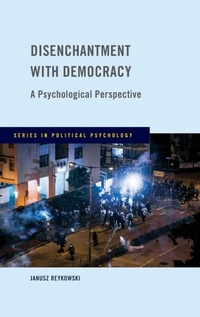
Disenchantment with Democracy
A Psychological Perspective
Published on 22. June 2020
Book
Hardback
276 pages
978-0-19-007858-4 (ISBN)
Description
In recent years, there has been a rise in social movements and organizations that challenge the very foundations of liberal democracy on a global scale. Discrepancies of interests, ideological or worldview contradictions, and identity differences are more likely now to transform into destructive conflicts, and violence is used as a legitimate method for attaining political and economic goals. Drawing on the knowledge accumulated in social and political psychology, this book scrutinizes these phenomena and provides an even deeper understanding of the nature of these conflicts. The book also addresses the imperfections of liberal institutions, which can exacerbate these divides, providing crucial context for understanding contemporary political tensions and their effects on the world's democracies.
Reviews / Votes
Recommended * Choice * "This is an important book, with a clear message, well organized and well documented. Ever since Habermas, we have been flooded with theories of democracy that see it as a result of a consensus resulting from rational deliberation. But these theories have been largely normative and based on a priori assumptions about rationality. Reykowski's attempt is ground-breaking in seeking to establish individual and social psychological bases of consensus building. He invokes a massive amount of empirical literature. Moreover, he has the distinction of having been a prominent participant in an event that best exemplifies the consensus building that he is after: the 1989 negotiations that led to the fall of communism in Poland. His account of these negotiations is riveting." * Adam Przeworski, Professor of Politics, New York University *More details
Series
Language
English
Place of publication
New York
United States
Target group
Professional and scholarly
Dimensions
Height: 240 mm
Width: 161 mm
Thickness: 19 mm
Weight
575 gr
ISBN-13
978-0-19-007858-4 (9780190078584)
Copyright in bibliographic data and cover images is held by Nielsen Book Services Limited or by the publishers or by their respective licensors: all rights reserved.
Schweitzer Classification
Other editions
Additional editions
E-Book
03/2020
OUP eBook
€60.99
Available for download
E-Book
03/2020
OUP eBook
€60.99
Available for download
Person
Janusz Reykowski is Professor of Psychology at the Polish Academy of Science and co-founder and Chairman (until 2013) of the Academic Council of the Warsaw School of Social Psychology. He is a member of the Academia Europea, a Past President of the Polish Psychological Association, Past President of the International Society of Political Psychology, and an Honorary Member of the Polish Society of Social Psychology. In the last three decades, his research has focused on political psychology, specifically on solving political conflicts and on the development of democratic attitudes. He has published 10 books and over 150 articles and chapters in various languages. He was also awarded the Sanford Prize for Lifetime Achievement in Political Psychology by the International Society of Political Psychology.
Content
Contents
Preface
Introduction
Chapter 1. Violence as a Means of Attaining Group Goals
Chapter 2: Differences in Mentality-- A Source of Ideological Conflicts
Chapter 3: Opposed Interests as a Source of Conflict
Chapter 4: Economic Freedom as an Ideology
Chapter 5: The Market System as a Psychological Mechanism
Chapter 6: The Sources of Disenchantment with Democracy
Chapter 7: Political Dialogue as an Instrument of the Democratic Policy Making
References
Preface
Introduction
Chapter 1. Violence as a Means of Attaining Group Goals
Chapter 2: Differences in Mentality-- A Source of Ideological Conflicts
Chapter 3: Opposed Interests as a Source of Conflict
Chapter 4: Economic Freedom as an Ideology
Chapter 5: The Market System as a Psychological Mechanism
Chapter 6: The Sources of Disenchantment with Democracy
Chapter 7: Political Dialogue as an Instrument of the Democratic Policy Making
References