


Retaking Rationality
How Cost Benefit Analysis Can Better Protect the Environment and Our Health
Published on 17. April 2008
Book
Hardback
262 pages
978-0-19-536857-4 (ISBN)
Description
That America's natural environment has been degraded and despoiled over the past 25 years is beyond dispute. Nor has there been any shortage of reasons why - short-sighted politicians, a society built on over-consumption, and the dramatic weakening of environmental regulations.
In Retaking Rationality, Richard Revesz and Michael Livermore argue convincingly that one of the least understood-and most important-causes of our failure to protect the environment has been a misguided rejection of reason. The authors show that environmentalists, labor unions, and other progressive groups have declined to participate in the key governmental proceedings concerning the cost-benefit analysis of federal regulations. As a result of this vacuum, industry groups have captured cost-benefit analysis and used it to further their anti-regulatory ends. Beginning in 1981, the federal Office of Management and Budget and the federal courts have used cost-benefit analysis extensively to determine which environmental, health, and safety regulations are approved and which are sent back to the drawing board. The resulting imbalance in political participation has profoundly affected the nation's regulatory and legal landscape. But Revesz and Livermore contend that economic analysis of regulations is necessary and that it needn't conflict with-and can in fact support-a more compassionate approach to environmental policy. Indeed, they show that we cannot give up on rationality if we truly want to protect our natural environment.
Retaking Rationality makes clear that by embracing and reforming cost-benefit analysis, and by joining reason and compassion, progressive groups can help enact strong environmental and public health regulation.
In Retaking Rationality, Richard Revesz and Michael Livermore argue convincingly that one of the least understood-and most important-causes of our failure to protect the environment has been a misguided rejection of reason. The authors show that environmentalists, labor unions, and other progressive groups have declined to participate in the key governmental proceedings concerning the cost-benefit analysis of federal regulations. As a result of this vacuum, industry groups have captured cost-benefit analysis and used it to further their anti-regulatory ends. Beginning in 1981, the federal Office of Management and Budget and the federal courts have used cost-benefit analysis extensively to determine which environmental, health, and safety regulations are approved and which are sent back to the drawing board. The resulting imbalance in political participation has profoundly affected the nation's regulatory and legal landscape. But Revesz and Livermore contend that economic analysis of regulations is necessary and that it needn't conflict with-and can in fact support-a more compassionate approach to environmental policy. Indeed, they show that we cannot give up on rationality if we truly want to protect our natural environment.
Retaking Rationality makes clear that by embracing and reforming cost-benefit analysis, and by joining reason and compassion, progressive groups can help enact strong environmental and public health regulation.
Reviews / Votes
"For anyone interested in how good public policy should be made in Washington, reading Retaking Rationality is the place to start. It is a well-reasoned, carefully documented, and well-written book."--Frederick A.O. Schwarz, Jr., Chief Counsel, Brennan Center for Justice at New York University School of Law and former Board Chair, Natural Resources Defense Council
"The application of cost-benefit analysis to environmental regulation is widely believed to have an inherent conservative bias. As Revesz and Livermore show in compelling detail, this is wrong. Cost-benefit analysis is simply a disciplined method of rationally assessing the consequences of proposed courses of action."
--Richard Posner, Judge of the U.S. Court of Appeals for the Seventh Circuit and author of Economic Analysis of Law (7th ed. 2007)
"Revesz and Livermore provide a thoughtful and compelling analysis of how cost-benefit analysis can and should be used to further the public good."
--Richard A. Meserve, President of the Carnegie Institution of Washington and former Chairman, US Nuclear Regulatory Commission
More details
Language
English
Place of publication
New York
United States
Target group
College/higher education
Dimensions
Height: 240 mm
Width: 161 mm
Thickness: 19 mm
Weight
564 gr
ISBN-13
978-0-19-536857-4 (9780195368574)
Copyright in bibliographic data and cover images is held by Nielsen Book Services Limited or by the publishers or by their respective licensors: all rights reserved.
Schweitzer Classification
Other editions
Additional editions
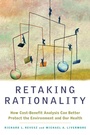
Richard L. Revesz | Michael A. Livermore
Retaking Rationality
How Cost-Benefit Analysis Can Better Protect the Environment and Our Health
Book
05/2011
Oxford University Press Inc
€48.90
Shipment within 15-20 days
Richard L. Revesz | Michael A. Livermore
Retaking Rationality
How Cost-Benefit Analysis Can Better Protect the Environment and Our Health
E-Book
04/2008
OUP eBook
€17.49
Available for download
Richard L. Revesz | Michael A. Livermore
Retaking Rationality
How Cost-Benefit Analysis Can Better Protect the Environment and Our Health
E-Book
04/2008
1st Edition
OUP eBook
€21.99
Available for download
Persons
Richard Revesz is the Dean of NYU's Law School and the author of Foundations of Environmental Law and Policy (OUP, 1997); Environmental Law, the Economy, and Sustainable Development. He lives in New York.
Michael Livermore is the Law Clerk to the Honorable Harry T. Edwards at the U.S. Court of Appeals for the D.C. Circuit.
Michael Livermore is the Law Clerk to the Honorable Harry T. Edwards at the U.S. Court of Appeals for the D.C. Circuit.
Content
Prologue: Reason and Compassion l ; Part I Decisions Are Made by Those Who Show Up ; The Case for Cost-Benefit Analysis ; The Walls Go Up ; Missed Opportunities ; Winning the Good Fight l ; Part II Eight Fallacies of Cost-Benefit Analysis ; 1: All Unintended Consequences Are Bad Fallacy ; 2: Wealth Equals Health Fallacy ; 3: Older People Are Less Valuable Fallacy ; 4: People Cannot Adapt Fallacy ; 5: People Always Want to Put Off Bad Things Fallacy ; 6: We Are Worth More than Our Children Fallacy ; 7: People Value Only What They Use Fallacy ; 8: Industry Cannot Adapt Fallacy ; The Sum of All the Fallaciesl ; Part III Instituting Regulatory Rationality ; Regulatory Hurdles ; Shaky Foundation ; Rethinking OIRA ; Balancing the Scalesl ; Epilogue: Self-Fulfilling Propheciesl ; Acknowledgments