

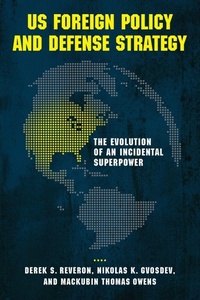
US Foreign Policy and Defense Strategy
The Evolution of an Incidental Superpower
Published on 15. December 2014
Book
Paperback/Softback
272 pages
978-1-62616-091-0 (ISBN)
Description
Safe from the battlefields of Europe and Asia, the United States led the post - World War II global economic recovery through international assistance and foreign direct investment. With an ardent decolonization agenda and a postwar legitimacy, the United States attempted to construct a world characterized by cooperation. When American optimism clashed with Soviet expansionism, the United States started on a path to global hegemony. In US Foreign Policy and Defense Strategy, the authors analyze the strategic underpinnings of hegemony, assess the national security establishment that sustains dominance, consider the impact on civil-military relations, and explore the intertwining relationships between foreign policy, defense strategy, and commercial activities. Eschewing conventional analyses, the volume not only identifies drivers and continuities in foreign policy, but it also examines how the legacy of the last sixty-five years will influence future national security policy that will be characterized by US leadership in an increasingly competitive world.
From civil-military relations to finance, and from competing visions of how America should make war to its philosophy of securing peace through reconstruction and reconciliation, US Foreign Policy and Defense Strategy offers unique insights into the links between military and commercial power as it charts the rise of a historical rarity: the incidental superpower. This accessibly written book is suitable for students and general readers as well as scholars.
From civil-military relations to finance, and from competing visions of how America should make war to its philosophy of securing peace through reconstruction and reconciliation, US Foreign Policy and Defense Strategy offers unique insights into the links between military and commercial power as it charts the rise of a historical rarity: the incidental superpower. This accessibly written book is suitable for students and general readers as well as scholars.
Reviews / Votes
Perfect for both the undergraduate and graduate classroom, since all its chapters include comprehensive, unbiased, concise, and quite readable reviews of the major concepts and debates regarding the subjects they cover. * H-Diplo * Despite having multiple authors, the book is not merely a compilation of their respective writings on related subjects but rather a well-integrated and superbly researched study. . . . The strength of the arguments presented in the book will not fade with time but will continue to be a scholarly source for understanding how the United States historically managed the challenges of being a superpower. . . . I highly recommend this book. * Strategic Studies Quarterly * An extremely useful compendium of the origins and fundamentals of . . . American global hegemony. * Classics of Strategy *More details
Language
English
Place of publication
Washington, DC
United States
Target group
Professional and scholarly
US School Grade: College Graduate Student and over
Product notice
Paperback (trade)
Illustrations
Not illustrated
Dimensions
Height: 229 mm
Width: 152 mm
Weight
363 gr
ISBN-13
978-1-62616-091-0 (9781626160910)
Copyright in bibliographic data and cover images is held by Nielsen Book Services Limited or by the publishers or by their respective licensors: all rights reserved.
Schweitzer Classification
Other editions
Additional editions
Derek S. Reveron | Nikolas K. Gvosdev | Mackubin Thomas Owens
US Foreign Policy and Defense Strategy
The Evolution of an Incidental Superpower
E-Book
12/2014
Georgetown University Press
€31.99
Available for download
Persons
Derek S. Reveron is a professor of national security affairs and the EMC Informationist Chair at the US Naval War College. He is the author or editor of several books including Cyberspace and National Security: Threats, Opportunities, and Power in a Virtual World. Nikolas K. Gvosdev is a professor of national security affairs at the US Naval War College and currently serves as the director of the Policy Analysis subcourse in the National Security Affairs Department. He is the author or editor of several books including Russian Foreign Policy: Interests, Vectors, and Sectors.Mackubin Thomas Owens is the editor of Orbis, the quarterly journal of the Foreign Policy Research Institute, and former professor of national security affairs at the US Naval War College. He is the author of US Civil-Military Relations after 9/11: Renegotiating the Civil-Military Bargain.
Content
Introduction 1 From Regional Power to Global Superpower2 The American Way of Organizing for Defense3 The American Way of Civil-Military Relations4 Drivers, Continuities, and Challenges of US Foreign Policy 5 The American Way of Warfare6 The American Way of Peace7 Financing the American Way8 Conclusion: The Future of US Foreign Policy and Defense Strategy About the Authors Index