

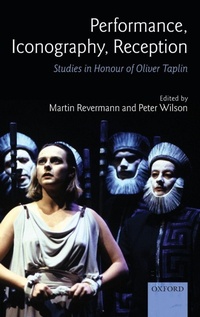
Performance, Iconography, Reception
Studies in Honour of Oliver Taplin
Published on 14. August 2008
Book
Hardback
600 pages
978-0-19-923221-5 (ISBN)
Description
Performance, Reception, Iconography assembles twenty-three papers from an international group of scholars who engage with, and develop, the seminal work of Oliver Taplin. Oliver Taplin has for over three decades been at the forefront of innovation in the study of Greek literature, and of the Greek theatre, tragic and comic, in particular. The studies in this volume centre on three key areas - the performance of Greek literature, the interactions between literature and the visual realm of iconography, and the reception and appropriation of Greek literature, and of Greek culture more widely, in subsequent historical periods.
Reviews / Votes
Literary scholarship has sometimes been accused of turning a blind eye to the realities of politics and power, but this and other essays in Performance are keenly aware of the fact that drama, even when it becomes "classical" does not inhabit a world of its own, but remains open to fresh interpretations, even wilful exploration. * Richard Rutherford, Times Literary Supplement *More details
Language
English
Place of publication
Oxford
United Kingdom
Illustrations
22 in-text illustrations
Dimensions
Height: 240 mm
Width: 161 mm
Thickness: 36 mm
Weight
1057 gr
ISBN-13
978-0-19-923221-5 (9780199232215)
Copyright in bibliographic data and cover images is held by Nielsen Book Services Limited or by the publishers or by their respective licensors: all rights reserved.
Schweitzer Classification
Persons
Martin Revermann is Associate Professor in Classics and Theatre Studies at the University of Toronto.
Peter Wilson is William Ritchie Professor of Classics at the University of Sydney.
Peter Wilson is William Ritchie Professor of Classics at the University of Sydney.
Content
Introduction ; PERFORMANCE: EXPLORATIONS ; 1. Generic Boundaries in Late Fifth-Century Athens ; 2. Audience and Emotion in the Reception of Greek Drama ; 3. Greek Middle-Brow Drama (Something to do with Aphrodite?) ; 4. Costing the Dionysia ; 5. Nothing to do with Demeter? Something to do with Sicily! Theatre and Society in the Early Fifth-Century West ; PERFORMANCE: EPIC ; 6. The Odyssey as Performance Poetry ; 7. Performance and Rivalry: Homer, Odysseus, and Hesiod ; 8. Performing the Will of Zeus: The Dios boule and the Scope of Early Greek Epic ; PERFORMANCE: TRAGEDY ; 9. Theatrical Furies: Thoughts on Eumenides ; 10. Aeschylus' Eumenides, Chronotopes, and the 'Aetiological Mode' ; 11. Star Choruses: Eleusis, Orphism, and New Musical Imagery and Dance ; 12. The Last Word: Ritual, Power, and Performance in Euripides' Hiketides ; 13. Intimate Relations: Children, Childbearing, and Parentage on the Euripidean Stage ; 14. Character and Characterization in Greek Tragedy ; PERFORMANCE: COMEDY ; 15. Scenes at the Door in Aristophanic Comedy ; 16. The Poetics of the Mask in Old Comedy ; PERFORMANCE: ICONOGRAPHY ; 17. Putting Performance into Focus ; 18. The Greek Gem: A Token of Recognition ; 19. Image and Representation in the Pottery of Magna Graecia ; PERFORMANCE: RECEPTION ; 20. Wagner's Greeks: The Politics of Hellenism ; 21. Resurrecting Ancient Greece in Nazi German: The Oresteia as Part of the Olympic Games in 1936 ; 22. Can the Odyssey ever be Tragic? Historical Perspectives on the Theatrical Realization of Greek Epic ; 23. An Oedipus for our Times? Yeats's Version of Sophocles' Oedipus Tyrannos