

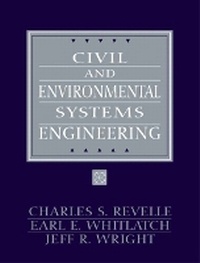
Civil and Environmental Systems Engineering
2nd Edition
Published on 11. September 2003
Book
Hardback
576 pages
978-0-13-047822-1 (ISBN)
Description
For junior/senior-level courses in Systems Analysis or Systems Analysis and Economics as applied to civil engineering. With a reorganization and new material, the Second Edition of this acclaimed text is designed to enhance the student's learning experience by providing exposure to modeling ideas and concepts. Network flow problems are emphasized by highlighting their study separately from the general integer programming models that are considered. With a wider range of examples and exercises that conclude many chapters, this text offers students an extremely practical, accessible study on the most modern skills available for the design, operation and evaluation of civil and environmental engineering systems.
More details
Edition
2nd edition
Language
English
Place of publication
United States
Publishing group
Pearson Education (US)
Target group
College/higher education
Dimensions
Height: 240 mm
Width: 183 mm
Thickness: 25 mm
Weight
984 gr
ISBN-13
978-0-13-047822-1 (9780130478221)
Copyright in bibliographic data and cover images is held by Nielsen Book Services Limited or by the publishers or by their respective licensors: all rights reserved.
Schweitzer Classification
Other editions
Previous edition
Charles S. Revelle | Earl Whitlatch | Jeff Wright
Civil and Environmental Systems Engineering
Book
09/1997
Pearson
€85.41
Article exhausted; check for reprint
Persons
The team of authors, ReVelle, Whitlatch, and Wright, is well credentialed to provide a text that delivers both solid technical content and quality communication. ReVelle, a professor at Johns Hopkins for more than 30 years, studied with one of the originators of systems analysis in water management and teaches a course in civil systems regularly. ReVelle is also the author, with his wife Penelope, of The Environment, a basic college text that has appeared in three editions, and more recently of The Global Environment. Whitlatch, a professor in civil engineering at Ohio State, has been teaching a popular and well-received civil systems course for over 25 years. Wright, the Dean of Engineering at University of California, Merced, and the founding editor-in-chief of The Journal of Infrastructure Systems, has been teaching courses on civil systems and engineering economics for more than 20 years. The authors have collaborated on research for three decades. All three authors have distinguished records of research and application. They enjoyed writing the text together and will be interested in your comments.
Content
1. Explaining Systems Analysis.
2. Models in Civil and Environmental Engineering.
3. A Graphical Solution Procedure and Further Examples.
4. The Simplex Algorithm for Solving Linear Programs.
5. Linear Programs with Multiple Objectives.
6. Linear Programming Models of Network Flow.
7. Integer Programming and Its Applications.
8. Scheduling Models: Critical Path Method.
9. Decision Theory.
10. Lessons in Context: Simulation and the Statistics of Prediction.
11. Lessons in Context: A Multigoal Water Resources Problem Utilizing Multiple Techniques.
12. Lessons in Context: Transportation Systems.
13. Dynamic Programming and Nonlinear Programming.
14. Engineering Economics I: Interest and Equivalence.
15. Engineering Economics II: Choice Between Alternatives.
16. Engineering Economics III: Depreciation, Taxes, Inflation, and Personal Financial Planning.
2. Models in Civil and Environmental Engineering.
3. A Graphical Solution Procedure and Further Examples.
4. The Simplex Algorithm for Solving Linear Programs.
5. Linear Programs with Multiple Objectives.
6. Linear Programming Models of Network Flow.
7. Integer Programming and Its Applications.
8. Scheduling Models: Critical Path Method.
9. Decision Theory.
10. Lessons in Context: Simulation and the Statistics of Prediction.
11. Lessons in Context: A Multigoal Water Resources Problem Utilizing Multiple Techniques.
12. Lessons in Context: Transportation Systems.
13. Dynamic Programming and Nonlinear Programming.
14. Engineering Economics I: Interest and Equivalence.
15. Engineering Economics II: Choice Between Alternatives.
16. Engineering Economics III: Depreciation, Taxes, Inflation, and Personal Financial Planning.