

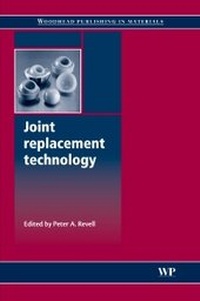
Joint Replacement Technology
New developments
Published on 9. July 2008
Book
Hardback
696 pages
978-1-84569-245-2 (ISBN)
Description
Joint replacement has been one of the major successes of modern medicine. Its continued success depends on effective collaboration between clinicians and researchers across many different areas in science and medicine. This important book brings together the wide range of research in this area and its implications for clinical practice.
The book sets the scene with introductory chapters on joint biomechanics and tribology, materials for joint replacement and their interactions with the body, and regulatory issues. Part two reviews the use of metals and ceramics as joint replacement materials, joint design, bone cements and cementless fixation techniques, failure mechanisms and ways of predicting the lifetime of replacement joints. The third part of the book summarises research on how prosthetic joints interact with the body, including biological causes of joint failure, sterilisation techniques and the use of drug delivery systems to enhance joint replacement. The final group of chapters reviews key issues in replacing particular joints including the hip, knee, ankle, shoulder and elbow as well as developments in intervertebral disc and tempero-mandibular joint replacement technology.
With its distinguished editor and international team of contributors, Joint replacement technology is a standard reference for the engineering and materials scientific communities, as well as surgeons seeking the best treatment for their patients.
The book sets the scene with introductory chapters on joint biomechanics and tribology, materials for joint replacement and their interactions with the body, and regulatory issues. Part two reviews the use of metals and ceramics as joint replacement materials, joint design, bone cements and cementless fixation techniques, failure mechanisms and ways of predicting the lifetime of replacement joints. The third part of the book summarises research on how prosthetic joints interact with the body, including biological causes of joint failure, sterilisation techniques and the use of drug delivery systems to enhance joint replacement. The final group of chapters reviews key issues in replacing particular joints including the hip, knee, ankle, shoulder and elbow as well as developments in intervertebral disc and tempero-mandibular joint replacement technology.
With its distinguished editor and international team of contributors, Joint replacement technology is a standard reference for the engineering and materials scientific communities, as well as surgeons seeking the best treatment for their patients.
More details
Series
Language
English
Place of publication
Cambridge
United Kingdom
Publishing group
Elsevier Science & Technology
Target group
College/higher education
Dimensions
Height: 234 mm
Width: 156 mm
Weight
1130 gr
ISBN-13
978-1-84569-245-2 (9781845692452)
Copyright in bibliographic data and cover images is held by Nielsen Book Services Limited or by the publishers or by their respective licensors: all rights reserved.
Schweitzer Classification
Other editions
New editions
Peter A. Revell
Joint Replacement Technology
Book
10/2018
2nd Edition
Woodhead Publishing Ltd
€222.84
The article will not be published
Peter A. Revell
Joint Replacement Technology
Book
06/2014
2nd Edition
Woodhead Publishing Ltd
€304.55
Article exhausted; check for reprint
Additional editions
Peter A. Revell
Joint Replacement Technology
E-Book
07/2008
Woodhead Publishing
€255.00
Available for download
Person
Dr Peter A. Revell is Emeritus Professor at University College London. Formerly Professor of Histopathology at the Royal Free and University College Medical School, he is a past President of the European Society of Biomaterials. Professor Revell is a Fellow both of The Royal College of Pathologists and the International Union of Societies for Biomaterials Science and Engineering.
Content
Part 1 Introduction: Biomechanics of joints; Tribology in joint replacement; Biomaterials and the chemical environment of the body; Materials for joint replacement; Regulatory issues affecting joint replacement: The case of the UK. Part 2 Material and mechanical issues: Metals for joint replacement; Ceramics for joint replacement; Joint bearing surfaces and replacement joint design; Cementless fixation techniques in joint replacement; Bone cement fixation: Acrylic cements; Bone cement fixation: Glass-ionomer cements; Failure mechanisms in joint replacement; Predicting the lifetime of joints: Clinical results. Part 3 The device biological environment: The healing response to implants used in joint replacement; Biological causes of prosthetic joint failure; Using drug delivery systems to enhance joint replacement; Sterilisation of joint replacement technology. Part 4 Specific joints: Hip replacement: Tribological principles, materials and engineering; Hip replacement: clinical perspectives; Knee replacement: Clinical perspectives; Intervertebral disc joint replacement technology; Replacing tempero-mandibular joints (TMJ); Replacing ankle joints; Replacing shoulder joints; Replacing elbow joints; Replacing joints with pyrolytic carbon.