

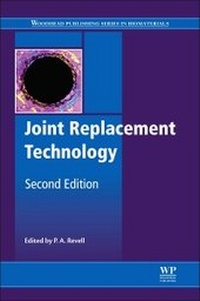
Joint Replacement Technology
2nd Edition
Published on 2. June 2014
Book
Hardback
724 pages
978-0-85709-841-2 (ISBN)
Description
This second edition of Joint Replacement Technology provides a thoroughly updated review of recent developments in joint replacement technology. Joint replacement is a standard treatment for joint degradation and has improved the quality of life of millions of patients. Collaboration between clinicians and researchers is critical to its continued success and to meet the rising expectations of patients and surgeons.
Part one introduces the advances in joint replacement technology, tribological considerations and experiments, and immune and regenerative responses to joint replacements. Part two covers the materials and techniques used in joint replacement. The advantages and disadvantages of different metals are explained here, as well as the use of ceramics. This section also addresses challenges in joint bearing surfaces, design, and cementless fixation techniques. Biological and mechanical issues are considered in part three, including healing responses to implants and biological causes of prosthetic joint failure, and a new chapter on imaging of joint prostheses. Each chapter in part four describes the clinical challenges of replacing specific joints, with specific focus on hip, knee, intervertebral disc joint, shoulder arthroplasty, elbow arthroplasty, and pyrocarbon small joint arthroplasty.
Thanks to its widespread collaboration and international contributors, Joint Replacement Technology is useful for materials scientists and engineers in both academia and biomedical industry. Chemists, clinicians, and other researchers in this area will also find it invaluable.
Part one introduces the advances in joint replacement technology, tribological considerations and experiments, and immune and regenerative responses to joint replacements. Part two covers the materials and techniques used in joint replacement. The advantages and disadvantages of different metals are explained here, as well as the use of ceramics. This section also addresses challenges in joint bearing surfaces, design, and cementless fixation techniques. Biological and mechanical issues are considered in part three, including healing responses to implants and biological causes of prosthetic joint failure, and a new chapter on imaging of joint prostheses. Each chapter in part four describes the clinical challenges of replacing specific joints, with specific focus on hip, knee, intervertebral disc joint, shoulder arthroplasty, elbow arthroplasty, and pyrocarbon small joint arthroplasty.
Thanks to its widespread collaboration and international contributors, Joint Replacement Technology is useful for materials scientists and engineers in both academia and biomedical industry. Chemists, clinicians, and other researchers in this area will also find it invaluable.
Reviews / Votes
"Chemists, surgeons, and other researchers will find it invaluable. With new authors and a section on imaging, this is a significant update to the 2008 edition. It is an essential addition to libraries frequented by the intended audience. 3 Stars - Score: 89" --Doody's.com, 2014More details
Series
Edition
2nd edition
Language
English
Place of publication
Cambridge
United Kingdom
Publishing group
Elsevier Science & Technology
Target group
College/higher education
Professional and scholarly
Dimensions
Height: 234 mm
Width: 156 mm
Weight
930 gr
ISBN-13
978-0-85709-841-2 (9780857098412)
Copyright in bibliographic data and cover images is held by Nielsen Book Services Limited or by the publishers or by their respective licensors: all rights reserved.
Schweitzer Classification
Other editions
New editions
Peter A. Revell
Joint Replacement Technology
Book
07/2021
3rd Edition
Woodhead Publishing
€330.50
Shipment within 15-20 days
Additional editions
Peter A. Revell
Joint Replacement Technology
Book
10/2018
2nd Edition
Woodhead Publishing Ltd
€222.84
The article will not be published
Peter A. Revell
Joint Replacement Technology
E-Book
08/2014
2nd Edition
Woodhead Publishing
€225.00
Available for download
Previous edition
Book
07/2008
Woodhead Publishing Ltd
€311.98
Article exhausted; check for reprint
Person
Dr Peter A. Revell is Emeritus Professor at University College London. Formerly Professor of Histopathology at the Royal Free and University College Medical School, he is a past President of the European Society of Biomaterials. Professor Revell is a Fellow both of The Royal College of Pathologists and the International Union of Societies for Biomaterials Science and Engineering.
Content
Part I Introduction to joint replacement technology
1. Developments in joint replacement technology
2. Tribology in joint replacement
3. Biological and chemical influence on immune and regenerative response to joint replacements
Part II Materials and techniques in joint replacement
4. Metals for joint replacement
5. Ceramics for joint replacement
6. Joint bearing surfaces and replacement joint design
7. Cementless fixation techniques and challenges in joint replacement
8. Acrylic cements for bone fixation in joint replacement
Part III Biological and mechanical issues in joint replacement
9. The healing response to implants used in joint replacement
10. Biological causes of prosthetic joint failure
11. Failure mechanisms in joint replacement
12. Tribology and corrosion in hip joint replacements: materials and engineering
13. Imaging of joint prostheses
Part IV Replacing specific joints
14. Hip replacement: clinical perspectives
15. Knee replacement: clinical perspectives
16. Intervertebral disc joint replacement technology
17. The history of shoulder arthroplasty
18. Elbow arthroplasty
19. Pyrocarbon small joint arthroplasty of the extremities
1. Developments in joint replacement technology
2. Tribology in joint replacement
3. Biological and chemical influence on immune and regenerative response to joint replacements
Part II Materials and techniques in joint replacement
4. Metals for joint replacement
5. Ceramics for joint replacement
6. Joint bearing surfaces and replacement joint design
7. Cementless fixation techniques and challenges in joint replacement
8. Acrylic cements for bone fixation in joint replacement
Part III Biological and mechanical issues in joint replacement
9. The healing response to implants used in joint replacement
10. Biological causes of prosthetic joint failure
11. Failure mechanisms in joint replacement
12. Tribology and corrosion in hip joint replacements: materials and engineering
13. Imaging of joint prostheses
Part IV Replacing specific joints
14. Hip replacement: clinical perspectives
15. Knee replacement: clinical perspectives
16. Intervertebral disc joint replacement technology
17. The history of shoulder arthroplasty
18. Elbow arthroplasty
19. Pyrocarbon small joint arthroplasty of the extremities