

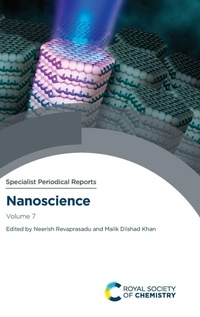
Nanoscience
Volume 7
Published on 14. July 2021
Book
Hardback
328 pages
978-1-83916-250-3 (ISBN)
Description
The field of nanoscience continues to grow and, with such a vast landscape of material, careful distillation of the most important discoveries will help researchers find the key information they require. Nanoscience provides a critical and comprehensive assessment of the most recent research and opinion from across the globe. Topics covered in this volume include 2D materials for Li-ion batteries, porous organic polymers as an emerging platform for photocatalytic water splitting, smart materials for gas detection and monitoring and redox enzyme-mimicking nanomaterials.
Covering energy, biological and nanomaterials applications, this volume appeals to anyone practising in nano-allied fields, or wishing to enter the nano-world. Readers will benefit from this resource as they are presented with the current thought and applications of nanoscience.
Covering energy, biological and nanomaterials applications, this volume appeals to anyone practising in nano-allied fields, or wishing to enter the nano-world. Readers will benefit from this resource as they are presented with the current thought and applications of nanoscience.
More details
Series
Language
English
Place of publication
Cambridge
United Kingdom
Target group
Professional and scholarly
Product notice
Unsewn / adhesive bound
Dimensions
Height: 234 mm
Width: 156 mm
Thickness: 25 mm
Weight
1811 gr
ISBN-13
978-1-83916-250-3 (9781839162503)
DOI
10.1039/9781839163791
Copyright in bibliographic data and cover images is held by Nielsen Book Services Limited or by the publishers or by their respective licensors: all rights reserved.
Schweitzer Classification
Other editions
Additional editions
E-Book
07/2021
1st Edition
Royal Society of Chemistry
€436.99
Available for download
E-Book
07/2021
1st Edition
Royal Society of Chemistry
€436.99
Available for download
Persons
Content
The Bio-Nano Interface as an Emerging Trend in Assembling Multi-Functional Metal Nanoparticles;
Redox Enzyme-Mimicking Nanomaterials: Classification, Activity Regulation Strategy and Biological Applications;
Synthesis of P-Conjugated Coumarins and their derivatives for Supramolecular Applications;
Emerging Two-Dimensional Nanomaterials as Electrocatalysts for Water-Splitting: Opportunities and Challenges;
Ligand Manipulation towards Stable Lead Halide Perovskite Nanocrystals;
Carbon-Based Nanomaterials for Advanced Flexible Lithium Ion Batteries;
Role of Photosensitizers in enhancing the performance of Nanocrystalline TiO2 for Photoelectrochemical Water Splitting;
Metal-Organic Precursors for the Solventless Synthesis of Metallic and Metal Chalcogenide Nanoparticles;
Porous Organic Polymers as an Emerging Platform for Photocatalysis;
Two-Dimensional Materials for Lithium-Ion Batteries
Redox Enzyme-Mimicking Nanomaterials: Classification, Activity Regulation Strategy and Biological Applications;
Synthesis of P-Conjugated Coumarins and their derivatives for Supramolecular Applications;
Emerging Two-Dimensional Nanomaterials as Electrocatalysts for Water-Splitting: Opportunities and Challenges;
Ligand Manipulation towards Stable Lead Halide Perovskite Nanocrystals;
Carbon-Based Nanomaterials for Advanced Flexible Lithium Ion Batteries;
Role of Photosensitizers in enhancing the performance of Nanocrystalline TiO2 for Photoelectrochemical Water Splitting;
Metal-Organic Precursors for the Solventless Synthesis of Metallic and Metal Chalcogenide Nanoparticles;
Porous Organic Polymers as an Emerging Platform for Photocatalysis;
Two-Dimensional Materials for Lithium-Ion Batteries