

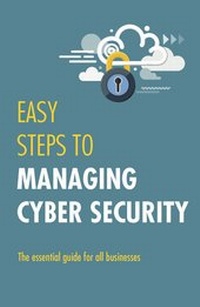
Easy Steps to Managing Cybersecurity
Published on 24. September 2018
Book
Paperback/Softback
146 pages
978-1-78719-796-1 (ISBN)
Description
An introductory guide to managing cybersecurity for businesses. How to prevent, protect and respond to threats.
Providing an insight to the extent and scale a potential damage could cause when there is a breech in cyber security. It includes case studies and advice from leading industry professionals, giving you the necessary strategies and resources to prevent, protect and respond to any threat:
- Introduction to cyber security
- Security framework
- Support services for UK public and private sectors
- Cyber security developments
- Routing a map for resilience
- Protecting financial data
- Countermeasures to advance threats
- Managing incidents and breaches
- Preparing for further threats
- Updating contingency plans
Providing an insight to the extent and scale a potential damage could cause when there is a breech in cyber security. It includes case studies and advice from leading industry professionals, giving you the necessary strategies and resources to prevent, protect and respond to any threat:
- Introduction to cyber security
- Security framework
- Support services for UK public and private sectors
- Cyber security developments
- Routing a map for resilience
- Protecting financial data
- Countermeasures to advance threats
- Managing incidents and breaches
- Preparing for further threats
- Updating contingency plans
More details
Language
English
Place of publication
London
United Kingdom
Publishing group
Legend Press Ltd
Target group
Professional and scholarly
Dimensions
Height: 198 mm
Width: 129 mm
Weight
40 gr
ISBN-13
978-1-78719-796-1 (9781787197961)
Copyright in bibliographic data and cover images is held by Nielsen Book Services Limited or by the publishers or by their respective licensors: all rights reserved.
Schweitzer Classification
Other editions
Additional editions
Jonathan Reuvid
Easy Steps to Managing Cybersecurity
E-Book
09/2018
Legend Business
€6.99
Available for download
Content
FOREWORD
Not so long ago, looking after national security was an exclusive government responsibility. The digital age has changed that - and permanently. These days it is not just the organs of the state and its infrastructure which are the direct object of cyberattack, it is also the private sector, and at all levels. Individuals and corporate entities have of course always been expected to take reasonable precautions against crime but in the past they have not been called upon to be active players in helping create the framework for secure conditions. But as the private sector is both victim and solutions provider, partnership with government in combatting cyber predators on the economy and security of the nation has become essential. Indeed, it is not too much to say that good cybersecurity and cyber resilience have become a duty for the corporate sector to which these essays are addressed.
But, as the authors point out, not everyone has got the message. As three of them put it: "there is a schism between the reality of cybersecurity risk and the number of businesses engaging sufficiently seriously with the threat". Better reporting of breaches may account for some of the estimated rise in the huge losses attributable to cyber crime but, however one reads the figures, there is only one conclusion to draw: we are currently losing the battle. The types of actors, their motives and their modus operandi vary, but they all have the following features in common: stealth in breaking in, difficulty of detection and attribution and, in consequence, a high likelihood of success at low cost.
Not so long ago, looking after national security was an exclusive government responsibility. The digital age has changed that - and permanently. These days it is not just the organs of the state and its infrastructure which are the direct object of cyberattack, it is also the private sector, and at all levels. Individuals and corporate entities have of course always been expected to take reasonable precautions against crime but in the past they have not been called upon to be active players in helping create the framework for secure conditions. But as the private sector is both victim and solutions provider, partnership with government in combatting cyber predators on the economy and security of the nation has become essential. Indeed, it is not too much to say that good cybersecurity and cyber resilience have become a duty for the corporate sector to which these essays are addressed.
But, as the authors point out, not everyone has got the message. As three of them put it: "there is a schism between the reality of cybersecurity risk and the number of businesses engaging sufficiently seriously with the threat". Better reporting of breaches may account for some of the estimated rise in the huge losses attributable to cyber crime but, however one reads the figures, there is only one conclusion to draw: we are currently losing the battle. The types of actors, their motives and their modus operandi vary, but they all have the following features in common: stealth in breaking in, difficulty of detection and attribution and, in consequence, a high likelihood of success at low cost.