

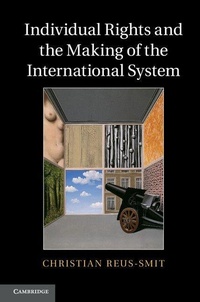
Individual Rights and the Making of the International System
Published on 29. August 2013
Book
Paperback/Softback
244 pages
978-0-521-67448-5 (ISBN)
Description
We live today in the first global system of sovereign states in history, encompassing all of the world's polities, peoples, religions and civilizations. Christian Reus-Smit presents a new account of how this system came to be, one in which struggles for individual rights play a central role. The international system expanded from its original European core in five great waves, each involving the fragmentation of one or more empires into a host of successor sovereign states. In the most important, associated with the Westphalian settlement, the independence of Latin America, and post-1945 decolonization, the mobilization of new ideas about individual rights challenged imperial legitimacy, and when empires failed to recognize these new rights, subject peoples sought sovereign independence. Combining theoretical innovation with detailed historical case studies, this book advances a new understanding of human rights and world politics, with individual rights deeply implicated in the making of the global sovereign order.
Reviews / Votes
'Chris Reus-Smit has written a groundbreaking book. By showing that, during the last five centuries, revolutionary ideas on individual rights were at the roots of the demand for sovereignty and de-legitimation of empires, and therefore, also of the expansion of international systems and the evolution of international order, [his] theoretical and empirical tour de force, more than most books in international relations, reveals the social nature of international systems and how international orders transform.' Emanuel Adler, Professor of Political Science and Andrea and Charles Bronfman Chair of Israeli Studies, University of Toronto 'An exciting story about the surprising political power of ideas concerning human rights in the critical junctures at which the international system has undergone its greatest expansions. I have long argued that human rights ought to matter - Reus-Smit has demonstrated that they repeatedly can, and do, matter fundamentally.' Henry Shue, Centre for International Studies, University of Oxford 'Reus-Smit has written a brilliant book - strikingly original in its argument, ambitious in scope, and meticulous in its research. It should change the way that international relations scholars think about the international system and the theories we use to explain change.' Kathryn Sikkink, Regents Professor, University of Minnesota 'Scholars have offered a variety of explanations for the rise and triumph of the nation-state. Reus-Smit argues that most accounts fail to explain why people wanted independent statehood in the first place. His answer is human rights.' G. John Ikenberry, Foreign AffairsMore details
Language
English
Place of publication
Cambridge
United Kingdom
Target group
Professional and scholarly
Product notice
Paperback (trade)
Dimensions
Height: 229 mm
Width: 152 mm
Thickness: 14 mm
Weight
368 gr
ISBN-13
978-0-521-67448-5 (9780521674485)
Copyright in bibliographic data and cover images is held by Nielsen Book Services Limited or by the publishers or by their respective licensors: all rights reserved.
Schweitzer Classification
Other editions
Additional editions
Christian Reus-Smit
Individual Rights and the Making of the International System
E-Book
09/2013
1st Edition
Cambridge University Press
€119.99
Available for download
Christian Reus-Smit
Individual Rights and the Making of the International System
Book
08/2013
Cambridge University Press
€139.70
Shipment within 15-20 days
Christian Reus-Smit
Individual Rights and the Making of the International System
E-Book
07/2013
1st Edition
Cambridge University Press
€26.49
Available for download
Person
Christian Reus-Smit is a Fellow of the Academy of the Social Sciences in Australia and Professor of International Relations at the University of Queensland. Among his previous books, he is author of American Power and World Order (2004) and The Moral Purpose of the State (1999); co-author of Special Responsibilities: Global Problems and American Power (2012); and editor of The Politics of International Law (2004).
Content
Introduction; 1. The expansion of the international system; 2. Struggles for individual rights; 3. The Westphalian settlement; 4. The independence of Spanish America; 5. Post-1945 decolonization; Conclusion.