

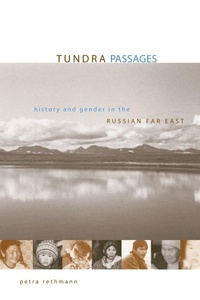
Tundra Passages
History and Gender in the Russian Far East
Published on 15. November 2000
Book
Paperback/Softback
248 pages
978-0-271-02058-7 (ISBN)
Description
Koriak have been described as a nomadic people, migrating with the reindeer through rugged terrain. Their autonomy and mobility are salient cultural features that ethnographers and state administrators have found equally fascinating and menacing.
Tundra Passages describes how this indigenous people in the Russian Far East have experienced, interpreted, and struggled with the changing conditions of life on the periphery of post-Soviet Russia.
Rethmann portrays the lives of Koriak women in the locales of Tymlat and Ossora in northern Kamchatka, within a wider framework of sexuality, state power, and marginalization, which she sees as central to the Koriak experience of everyday life. Using gender as a lens through which to examine wider issues of history, disempowerment, and marginalization, she explores the interpretations and strategies employed by Koriak women and men to ameliorate the austere effects of political and socioeconomic disorder. Rethmann's innovative work combines historical and ethnographic descriptions of Koriak life, narration, and practices of gender and history.
With the demise of the Soviet Union, scholars have begun an active discussion of the political processes that affect marginalized and indigenous peoples in Russia. This work contributes to this discussion by revealing the tensions and potentially contradictory strategies of indigenous people within a world shaken by change, uncertainty, and disorder.
Tundra Passages describes how this indigenous people in the Russian Far East have experienced, interpreted, and struggled with the changing conditions of life on the periphery of post-Soviet Russia.
Rethmann portrays the lives of Koriak women in the locales of Tymlat and Ossora in northern Kamchatka, within a wider framework of sexuality, state power, and marginalization, which she sees as central to the Koriak experience of everyday life. Using gender as a lens through which to examine wider issues of history, disempowerment, and marginalization, she explores the interpretations and strategies employed by Koriak women and men to ameliorate the austere effects of political and socioeconomic disorder. Rethmann's innovative work combines historical and ethnographic descriptions of Koriak life, narration, and practices of gender and history.
With the demise of the Soviet Union, scholars have begun an active discussion of the political processes that affect marginalized and indigenous peoples in Russia. This work contributes to this discussion by revealing the tensions and potentially contradictory strategies of indigenous people within a world shaken by change, uncertainty, and disorder.
Reviews / Votes
"Petra Rethmann's evocative Tundra Passages breaks completely new ground in ethnography from the Russian Far East. Drawing on conversations and experiences shared with Koriak women living on northeastern Kamchatka peninsula, she conveys the human dignity and creative energy that persist in the midst of social suffering following the breakdown of the Soviet empire. Rethmann demonstrates how historical conditions and regional inequalities affect the lives of women who struggle to make a better world for themselves and their families. This is ethnography at its very best."-Julie Cruikshank, University of British Columbia "This book is important for anyone hoping to keep pace with the whirlwind of change besetting Native Siberia. Each of its nine chapters is filled with the quiet drama of people in transition."
-E.J. Vajda Choice "Post-Soviet ethnography is expanding its gaze, due in part to a surging interest in regions of the former Soviet Union that have been recently opened to the outside world. Petra Rethmann's book represents an important contribution to this expansion. Her book sheds light on a region and group poorly represented in the ethnographic literature, the Koriak of the northeastern part of the Kamchatka Peninsula."
-Edmund (Ned) Searles American Journal of Sociology "This book makes an original and creative contribution that breaks new ground in ethnography from the Russian Far East."
-Julie Cruikshank Current Anthropology
More details
Series
Language
English
Place of publication
Pennsylvania
United States
Target group
College/higher education
Professional and scholarly
Product notice
Paperback (trade)
Illustrations
2 Maps; 11 Halftones, black and white
Dimensions
Height: 229 mm
Width: 155 mm
Thickness: 17 mm
Weight
404 gr
ISBN-13
978-0-271-02058-7 (9780271020587)
Copyright in bibliographic data and cover images is held by Nielsen Book Services Limited or by the publishers or by their respective licensors: all rights reserved.
Schweitzer Classification