

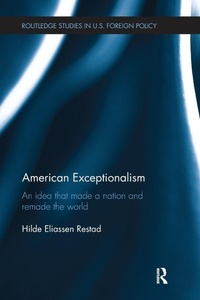
American Exceptionalism
An Idea that Made a Nation and Remade the World
1st Edition
Published on 16. June 2017
Book
Paperback/Softback
284 pages
978-1-138-09676-9 (ISBN)
Description
How does American exceptionalism shape American foreign policy? Conventional wisdom states that American exceptionalism comes in two variations - the exemplary version and the missionary version.
Being exceptional, experts in U.S. foreign policy argue, means that you either withdraw from the world like an isolated but inspiring "city upon a hill," or that you are called upon to actively lead the rest of the world to a better future. In her book, Hilde Eliassen Restad challenges this assumption, arguing that U.S. history has displayed a remarkably constant foreign policy tradition, which she labels unilateral internationalism. The United States, Restad argues, has not vacillated between an "exemplary" and a "missionary" identity. Instead, the United States developed an exceptionalist identity that, while idealizing the United States as an exemplary "city upon a hill," more often than not errs on the side of the missionary crusade in its foreign policy. Utilizing the latest historiography in the study of U.S. foreign relations, the book updates political science scholarship and sheds new light on the role American exceptionalism has played - and continues to play - in shaping America's role in the world.
This work will be of great interest to students and scholars of US foreign policy, security studies, and American politics.
Being exceptional, experts in U.S. foreign policy argue, means that you either withdraw from the world like an isolated but inspiring "city upon a hill," or that you are called upon to actively lead the rest of the world to a better future. In her book, Hilde Eliassen Restad challenges this assumption, arguing that U.S. history has displayed a remarkably constant foreign policy tradition, which she labels unilateral internationalism. The United States, Restad argues, has not vacillated between an "exemplary" and a "missionary" identity. Instead, the United States developed an exceptionalist identity that, while idealizing the United States as an exemplary "city upon a hill," more often than not errs on the side of the missionary crusade in its foreign policy. Utilizing the latest historiography in the study of U.S. foreign relations, the book updates political science scholarship and sheds new light on the role American exceptionalism has played - and continues to play - in shaping America's role in the world.
This work will be of great interest to students and scholars of US foreign policy, security studies, and American politics.
Reviews / Votes
Restad's book sheds new light by making a very substantial contribution to the literature on American exceptionalism and its role in shaping US foreign policy. Restad (Bjorknes College, Norway) challenges the traditional assumptions of US foreign policy experts that the US should either withdraw from the world like an isolated but inspiring "city upon a hill" or actively lead the rest of the world. --K. M. Zaarour, Shaw University CHOICE"Hilde Eliassen Restad has accomplished a difficult and important task in reviewing exceptionalism's centrality in the American self-understanding. ... Restad, a Norwegian scholar and teacher trained in the United States, uses her unique background to bring a fresh perspective to exceptionalism and American foreign policy. As an outsider who knows America well, she places the nation's experience in its wider international context and never takes for granted the truth of conventional stories trapped by a priori scholarly commitments to cycles, periods, breaks, and "turnarounds." One of the book's most commendable features is its success in forcing readers to engage its argument. This is a book to wrestle with, a book far from bland theorizing." -- Richard Gamble, Professor of History, Anna Margaret Ross Alexander Chair in History and Political Science at Hillsdale College
"In American exceptionalism, Hilde Restad provides a tightly argued and provocative overview of America's sense of self. ... Hilde Restad is, if anything, bold to seek an ideational study of exceptionalism amid the mine-strewn landscape of the ongoing American culture wars." -- Asle Toje, Director of Research at the Nobel Institute, writes in International Affairs Restad's book sheds new light by making a very substantial contribution to the literature on American exceptionalism and its role in shaping US foreign policy. Restad (Bjorknes College, Norway) challenges the traditional assumptions of US foreign policy experts that the US should either withdraw from the world like an isolated but inspiring "city upon a hill" or actively lead the rest of the world. --K. M. Zaarour, Shaw University CHOICE
More details
Series
Language
English
Place of publication
London
United Kingdom
Publishing group
Taylor & Francis Ltd
Target group
College/higher education
Product notice
Paperback (trade)
Dimensions
Height: 234 mm
Width: 156 mm
Thickness: 15 mm
Weight
406 gr
ISBN-13
978-1-138-09676-9 (9781138096769)
Copyright in bibliographic data and cover images is held by Nielsen Book Services Limited or by the publishers or by their respective licensors: all rights reserved.
Schweitzer Classification
Other editions
Additional editions
Book
12/2014
1st Edition
Routledge
€232.00
Shipment within 15-20 days
E-Book
12/2014
1st Edition
Routledge
€52.49
Available for download
E-Book
12/2014
1st Edition
Routledge
€52.99
Available for download
Person
Hilde Eliassen Restad is Associate Professor of Peace and Conflict Studies at Bjorknes College in Oslo, Norway. A Fulbright alumna, she has a Ph.D. in Foreign Affairs from the University of Virginia, and is frequently used as a commentator on U.S. politics in Norway.
Content
1 Introduction: How to be an American PART I: The Distinction: A Superior Nation is Born, 2. Challenging the conventional depiction of American identity, 3. Challenging the conventional depiction of U.S. foreign policy PART II The Mission: A Special Role Cast for the United States in the Play of World History, 4. The 'turn-around' theory and the many meanings of multilateral, 5. Early twentieth century internationalism: The triumph of Henry Cabot Lodge over Woodrow Wilson, 6. Turn-around? The triumph of hegemony over multilateralism PART III: The Resistance: American Exceptionalism and the Laws of History 7. From the post-Cold War order to the war on terror: American exceptionalism reaffirmed, 8. Conclusion: American exceptionalism today.