

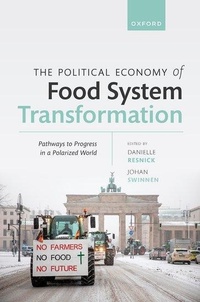
The Political Economy of Food System Transformation
Pathways to Progress in a Polarized World
Published on 16. October 2023
Book
Hardback
400 pages
978-0-19-888212-1 (ISBN)
Description
This is an open access title available under the terms of a CC BY-NC 4.0 International licence. It is free to read at Oxford Academic and offered as a free PDF download from OUP and selected open access locations.
The current structure of the global food system is increasingly recognized as unsustainable. In addition to the environmental impacts of agricultural production, unequal patterns of food access and availability are contributing to non-communicable diseases in middle- and high-income countries and inadequate caloric intake and dietary diversity among the world's poorest. To this end, there have been a growing number of academic and policy initiatives aimed at advancing food system transformation, including the 2021 UN Food Systems Summit, the Sustainable Development Goals (SDGs), and several UN Climate conferences. Yet, the policy pathways for achieving a transformed food system are highly contested, and the enabling conditions for implementation are frequently absent. Furthermore, a broad range of polarizing factors affect decisions over the food system at domestic and international levels - from debates over values and (mis)information, to concerns over food self-sufficiency, corporate influence, and human rights.
This volume explicitly analyses the political economy dynamics of food system transformation with contributors who span several disciplines, including economics, ecology, geography, nutrition, political science, and public policy. The chapters collectively address the range of interests, institutions, and power in the food system, the diversity of coalitions that form around food policy issues and the tactics they employ, the ways in which policies can be designed and sequenced to overcome opposition to reform, and processes of policy adaptation and learning. Drawing on original surveys, interviews, empirical modelling, and case studies from China, the European Union, Germany, Mexico, South Asia, sub-Saharan Africa, and the United States, the book touches on issues as wide ranging as repurposing agricultural subsidies, agricultural trade, biotechnology innovations, red meat consumption, sugar-sweetened beverage taxes, and much more.
The current structure of the global food system is increasingly recognized as unsustainable. In addition to the environmental impacts of agricultural production, unequal patterns of food access and availability are contributing to non-communicable diseases in middle- and high-income countries and inadequate caloric intake and dietary diversity among the world's poorest. To this end, there have been a growing number of academic and policy initiatives aimed at advancing food system transformation, including the 2021 UN Food Systems Summit, the Sustainable Development Goals (SDGs), and several UN Climate conferences. Yet, the policy pathways for achieving a transformed food system are highly contested, and the enabling conditions for implementation are frequently absent. Furthermore, a broad range of polarizing factors affect decisions over the food system at domestic and international levels - from debates over values and (mis)information, to concerns over food self-sufficiency, corporate influence, and human rights.
This volume explicitly analyses the political economy dynamics of food system transformation with contributors who span several disciplines, including economics, ecology, geography, nutrition, political science, and public policy. The chapters collectively address the range of interests, institutions, and power in the food system, the diversity of coalitions that form around food policy issues and the tactics they employ, the ways in which policies can be designed and sequenced to overcome opposition to reform, and processes of policy adaptation and learning. Drawing on original surveys, interviews, empirical modelling, and case studies from China, the European Union, Germany, Mexico, South Asia, sub-Saharan Africa, and the United States, the book touches on issues as wide ranging as repurposing agricultural subsidies, agricultural trade, biotechnology innovations, red meat consumption, sugar-sweetened beverage taxes, and much more.
More details
Language
English
Place of publication
Oxford
United Kingdom
Product notice
sewn/stitched
Cloth over boards
Dimensions
Height: 237 mm
Width: 158 mm
Thickness: 31 mm
Weight
756 gr
ISBN-13
978-0-19-888212-1 (9780198882121)
Copyright in bibliographic data and cover images is held by Nielsen Book Services Limited or by the publishers or by their respective licensors: all rights reserved.
Schweitzer Classification
Other editions
Additional editions
Danielle Resnick | Johan Swinnen
The Political Economy of Food System Transformation
Pathways to Progress in a Polarized World
E-Book
10/2023
1st Edition
OUP eBook
€110.99
Available for download
Danielle Resnick | Johan Swinnen
The Political Economy of Food System Transformation
Pathways to Progress in a Polarized World
E-Book
09/2023
1st Edition
OUP eBook
€98.99
Available for download
Persons
Danielle Resnick is a David M. Rubenstein Fellow in the Global Economy and Development Program at the Brookings Institution and a Non-Resident Fellow at the International Food Policy Research Institute (IFPRI). She was formerly a Senior Research Fellow and Governance Theme Leader at IFPRI (2013-2021), and a Research Fellow at the United Nations University-World Institute for Development Economics Research (UNU-WIDER, 2010-2013). Key research areas include the political economy of agriculture and food policy, decentralization, urban governance, informality, and democratization, with a regional specialization in sub-Saharan Africa where she has conducted fieldwork in more than a dozen countries.
Johan Swinnen is Director General of the International Food Policy Research Institute and Managing Director of Systems Transformation, CGIAR. From 2005 to 2019, he was a Professor of Economics and Director of the LICOS Centre for Institutions & Economic Performance at KU Leuven and Senior Research Fellow at the Centre for European Policy Studies in Brussels. He previously was also a Lead Economist at the World Bank (2003-2004) and economic adviser to the European Commission (1998-2001). He is a Fellow of Agricultural & Applied Economics Association and previously served as President of the International Association of Agricultural Economists (2012-2015).
Johan Swinnen is Director General of the International Food Policy Research Institute and Managing Director of Systems Transformation, CGIAR. From 2005 to 2019, he was a Professor of Economics and Director of the LICOS Centre for Institutions & Economic Performance at KU Leuven and Senior Research Fellow at the Centre for European Policy Studies in Brussels. He previously was also a Lead Economist at the World Bank (2003-2004) and economic adviser to the European Commission (1998-2001). He is a Fellow of Agricultural & Applied Economics Association and previously served as President of the International Association of Agricultural Economists (2012-2015).
Editor
David M. Rubenstein Research Fellow, Brookings Institution, and Non-Resident FellowDavid M. Rubenstein Research Fellow, Brookings Institution, and Non-Resident Fellow, International Food Policy Research Institute (IFPRI)David M. Rubenstein Research Fellow, Brookings Institution, and Non-Resident Fellow, International Food Policy Research Institute (IFPRI)
Managing Director of Systems Transformation, CGIAR, and Director GeneralManaging Director of Systems Transformation, CGIAR, and Director General, International Food Policy Research Institute (IFPRI)Managing Director of Systems Transformation, CGIAR, and Director General, International Food Policy Research Institute (IFPRI)
Content
- 1: Danielle Resnick and Johan Swinnen: Introduction: Political Economy of Food System Transformation
- 2: Koen Deconinck: Facts, Interests, and Values: Identifying Points of Convergence and Divergence for Food Systems
- 3: Rob Vos, Will Martin, and Danielle Resnick: The Political Economy of Reforming Agricultural Support Policies
- 4: Kym Anderson and Anna Strutt: From Re-instrumenting to Re-purposing Farm Support Policies
- 5: Johan Swinnen and Danielle Resnick: Policy Coalitions in Food Systems Transformation
- 6: Eduardo J. Gómez: Government Response to Ultra-Processed and Sugar Beverages Industries in Developing Nations: The Need to Build Coalitions Across Policy Sectors
- 7: Jonathan Mockshell and Thea Nielsen Ritter: Ultra-processed Food Environments: Aligning Policy Beliefs from the State, Market, and Civil Society
- 8: Jody Harris: Asymmetric Power in Global Food System Advocacy
- 9: Christopher B. Barrett: The Political Economy of Bundling Socio-Technical Innovations to Transform Agri-Food Systems
- 10: Robert Paarlberg: Sustainable Food and Farming: When Public Perceptions Depart from Science
- 11: Lukas Paul Fesenfeld and Yixian Sun: Enabling Positive Tipping Points in Public Support for Food System Transformation: The Case of Meat Consumption
- 12: Gareth Haysom and Jane Battersby: Urban Food Systems Governance in Africa: Towards a Realistic Model for Transformation
- 13: Alan Matthews, Jeroen Candel, Nel de Mûelenaere, and Pauline Scheelbeek: The Political Economy of Food System Transformation in the European Union
- 14: Stella Nordhagen and Jessica Fanzo: Tracking Progress and Generating Accountability for Global Food System Commitments
- 15: Danielle Resnick and Johan Swinnen: Conclusions