

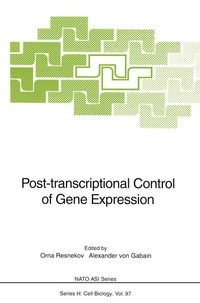
Post-transcriptional Control of Gene Expression
Published on 22. September 2011
Book
Paperback/Softback
XVI, 267 pages
978-3-642-64609-6 (ISBN)
Description
Many important cellular processes rely on posttranscriptional control of gene expression. This book describes the mechanisms of gene expression at this level that occur in the cytoplasm of prokaryotes and eukaryotes. Several introductory chapters discuss the general principles of translation and mRNA stability. The interactions of mature mRNA with the translational machinery, the components of mRNA degradation and antisense RNA are surveyed. Subsequent chapters discuss protein folding, transport, modification and degradation. The book is an invaluable source of information for both newcomers and those wishing an overview of the field.
More details
Series
Edition
Softcover reprint of the original 1st ed. 1996
Language
English
Place of publication
Berlin
Germany
Publishing group
Springer Berlin
Target group
Professional and scholarly
Research
Illustrations
XVI, 267 p.
Dimensions
Height: 235 mm
Width: 155 mm
Thickness: 16 mm
Weight
446 gr
ISBN-13
978-3-642-64609-6 (9783642646096)
DOI
10.1007/978-3-642-60929-9
Schweitzer Classification
Other editions
Additional editions
Orna Resnekov | Alexander von Gabain
Post-transcriptional Control of Gene Expression
Book
05/1996
Springer
€85.55
Article exhausted; check different version
Content
Regulation of Eukaryotic Gene Expression at the Level of mRNA Stability: Emergence of General Principles.- Enzymes Involved in Control of mRNA Decay in E. coli.- Mechanisms and Structural Determinants of mRNA Decay in Bacteria.- Changes in the Length of Poly(A) Tails and Their Effects on mRNA Translation and Turnover.- Mechanism and Regulation of Translation Initiation in Prokaryotes.- Regulation of Peptide Chain Termination.- Structure-Function Correlations in the Bacterial Ribosome.- Initiation Factor-Dependent Extracts: a Tool to Study Translation Initiation in Eukaryotes.- RNA-Protein Recognition and Basic Mechanisms of Translational Repression in Prokaryotes.- Translational Control in Escherichia coli and Saccharomyces cerevisiae.- Translational Control in Eukaryotic Cells: Principles Learned From the IRE/IRF System.- Frameshifting in Prokaryotes and Eukaryotes.- The Control, Detection and Exploitation of Translational Errors.- Isolation and Characterization of Eukaryotic Translation Initiation, Elongation and Termination Factors.- The Phosphorylation of Eukaryotic Initiation Factor 2 and Its Role in the Regulation of Translation During Viral Infection.- Selective Proteolysis by the Ubiquitin System.- The Role of Molecular Chaperones HSP70 and HSP60 in Protein Folding.- Components and Mechanisms Involved in Protein Translocation Across the Endoplasmic Reticulum Membrane.- Export of Proteins From Bacteria and Translocation of Proteins Across the Endoplasmic Reticulum of Eukaryotic cells; a Comparison.- Antisense RNA.