

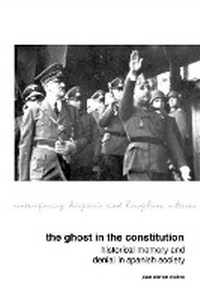
The Ghost in the Constitution
Historical Memory and Denial in Spanish Society
Published on 1. August 2021
Book
Paperback/Softback
344 pages
978-1-80085-574-8 (ISBN)
Description
The Ghost in the Constitution offers a reflection on the political use of the concept of historical memory foregrounding the case of
Spain. The book analyses the philosophical implications of the transference of the notion of memory from the individual consciousness to the collective subject and considers the conflation of epistemology with ethics. A subtheme is the origins and transmission of political violence, and its endurance in the form of symbolic violence and "negationism" in the post-Franco era. Some chapters treat of specific "traumatic" phenomena such as the bombing of Guernica and the Holocaust.
Spain. The book analyses the philosophical implications of the transference of the notion of memory from the individual consciousness to the collective subject and considers the conflation of epistemology with ethics. A subtheme is the origins and transmission of political violence, and its endurance in the form of symbolic violence and "negationism" in the post-Franco era. Some chapters treat of specific "traumatic" phenomena such as the bombing of Guernica and the Holocaust.
Reviews / Votes
Reviews'Intellectually engaging, thoughtful, coherent, and logically developed. Resina writes with an elegance of style uncommon among scholars ...the most apt synthesis and expansion of ideas on memory and latency that I have read in recent years.'
David Herzberger, University of California Riverside 'There is
ample thought-provoking material and some stimulating insight in The Ghost in
the Constitution, resulting from extensive research presented in polished
writing.'
Jose Colmeiro, Journal of Spanish Cultural Studies
More details
Series
Language
English
Place of publication
Liverpool
United Kingdom
Target group
Professional and scholarly
Dimensions
Height: 234 mm
Width: 156 mm
ISBN-13
978-1-80085-574-8 (9781800855748)
Copyright in bibliographic data and cover images is held by Nielsen Book Services Limited or by the publishers or by their respective licensors: all rights reserved.
Schweitzer Classification
Person
Joan Ramon Resina is Professor of Iberian Cultures and Comparative Literature at Stanford.
Content
Acknowledgments ix
Introduction 1
1 Historical Memory and
the Limits of Retrospection 9
2 Why Memory? Reflections
on a Politics of Mourning 22
3 Memory and Imputation 39
4 Denial and the Ethics of
Memory 58
5 Warming Up for the War:
The Cultural Transmission of Violence in Spain since the Early Twentieth
Century 72
6 Guernica as a Sign of
History 103
7 Delenda est Catalonia: The Unwelcome Memory 114
8 Allez, Allez! The 1939 Exodus from Catalonia and Internment in
French Concentration Camps 135
9 The Corpse in One's Bed:
Merce Rodoreda and the Concentrationary Universe 147
10 Transatlantic
Reversals: Exile and Anti-History 155
11 The Weight of Memory
and the Lightness of Oblivion: The Dead of the Spanish Civil War 168
12 Between Testimony and
Fiction: Jorge Semprun's Autobiographical Memory 184
13 It Wasn't This: Latency
and Epiphenomenon of the Transition 224
14 Window of Opportunity:
The Television Documentary as After-Image of the War 243
15 Anachronism and Latency
in Spanish Democracy 260
16 Negationism and Freedom
of Speech 276
17 Exhaustion of the
Transition Pact: Revisionism and Symbolic Violence 292
Bibliography 307
Index 323
Introduction 1
1 Historical Memory and
the Limits of Retrospection 9
2 Why Memory? Reflections
on a Politics of Mourning 22
3 Memory and Imputation 39
4 Denial and the Ethics of
Memory 58
5 Warming Up for the War:
The Cultural Transmission of Violence in Spain since the Early Twentieth
Century 72
6 Guernica as a Sign of
History 103
7 Delenda est Catalonia: The Unwelcome Memory 114
8 Allez, Allez! The 1939 Exodus from Catalonia and Internment in
French Concentration Camps 135
9 The Corpse in One's Bed:
Merce Rodoreda and the Concentrationary Universe 147
10 Transatlantic
Reversals: Exile and Anti-History 155
11 The Weight of Memory
and the Lightness of Oblivion: The Dead of the Spanish Civil War 168
12 Between Testimony and
Fiction: Jorge Semprun's Autobiographical Memory 184
13 It Wasn't This: Latency
and Epiphenomenon of the Transition 224
14 Window of Opportunity:
The Television Documentary as After-Image of the War 243
15 Anachronism and Latency
in Spanish Democracy 260
16 Negationism and Freedom
of Speech 276
17 Exhaustion of the
Transition Pact: Revisionism and Symbolic Violence 292
Bibliography 307
Index 323