

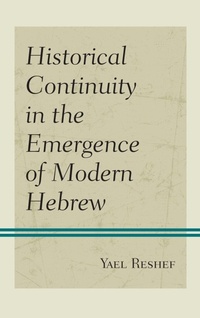
Historical Continuity in the Emergence of Modern Hebrew
Published on 13. November 2019
Book
Hardback
150 pages
978-1-4985-8449-4 (ISBN)
Description
Historical Continuity in the Emergence of Modern Hebrew offers a new perspective on the emergence processes of Modern Hebrew and its relationship to earlier forms of Hebrew. Based on a textual examination of select case studies of language use throughout the modernization of Hebrew, this book shows that due to the unconventional sociolinguistic circumstances in the budding speech community, linguistic processes did not necessarily evolve in a linear manner, blurring the distinction between true and apparent historical continuity. The emergent language's standardization involved the restructuring of linguistic habits that had initially taken root among the first speakers, often leading to a retreat from early contact-induced or non-classical phenomena. Yael Reshef demonstrates that as a result, superficial similarity to earlier forms of Hebrew did not necessarily stem from continuity, and deviation from canonical Hebrew features does not necessarily stem from change.
Reviews / Votes
This carefully researched, well-documented, and richly illustrated volume adds new and important insights into the puzzling question of the relationship between Modern Hebrew and its classical forebears (Biblical, Rabbinical, and Medieval) as representing change and/or continuity. The book will be of interest to Hebraists, general and Semitic linguists, and typologists, and its contents are accessible both to established scholars and to beginning students in these domains. -- Ruth A. Berman, Tel Aviv University Yael Reshef provides a fascinating look at the emergence of Modern Hebrew. By focusing on the struggle between linguistic continuity and innovation in the early years of Hebrew's revival, her work helps us understand how exactly Hebrew developed into its present form. -- Aaron Rubin, Penn State University In the detailed and theoretically-informed empirical studies in this book, Yael Reshef takes us beyond the myths, presuppositions, and speculations that characterize most discussions of the emergence of Modern Hebrew. Reshef uncovers how the particular history of Modern Hebrew and its diverse speakers led to surprising, non-linear, and hitherto invisible processes that shaped the language. It will fascinate anyone interested in Hebrew or in language variation and change -- and it made me completely rethink my conceptions of continuity and change in language. -- Eitan Grossman, Hebrew University of Jerusalem This volume provides a clear, concise overview of the issue of historical continuity as a factor in the emergence of Modern Hebrew. It makes an important contribution to scholarship in its examination of the question of superficial vs. actual continuity between earlier Hebrew sources and the nascent modern language. The work will be of great use to scholars and students seeking to understand the early development of contemporary Hebrew. -- Lily Kahn, University College LondonMore details
Language
English
Place of publication
United States
Publishing group
Bloomsbury Publishing Plc
Target group
Professional and scholarly
Illustrations
6 tables;
Dimensions
Height: 235 mm
Width: 157 mm
Thickness: 13 mm
Weight
378 gr
ISBN-13
978-1-4985-8449-4 (9781498584494)
Copyright in bibliographic data and cover images is held by Nielsen Book Services Limited or by the publishers or by their respective licensors: all rights reserved.
Schweitzer Classification
Other editions
Additional editions
E-Book
11/2019
1st Edition
Lexington Books
€90.99
Available for download
E-Book
11/2019
1st Edition
Bloomsbury eBooks US
€90.99
Available for download
Person
Yael Reshef is professor at the Hebrew University of Jerusalem and a member of the Academy of the Hebrew Language.
Content
Acknowledgments
Chapter 1: History, Culture, and the Speech Community
Chapter 2: Emergent Modern Hebrew as a Distinct Linguistic Phase
Chapter 3: The Role of Inherited Non-Classical Elements in the Emergence of a Colloquial Register
Chapter 4: The Rise and Fall of Honorifics
Chapter 5: Adjective Grading - The Formation of a Paradigm
Chapter 6: The Standardization of Action Nouns
Chapter 7: True and Apparent Continuity in the Genesis of Modern Hebrew
Bibliography
Chapter 1: History, Culture, and the Speech Community
Chapter 2: Emergent Modern Hebrew as a Distinct Linguistic Phase
Chapter 3: The Role of Inherited Non-Classical Elements in the Emergence of a Colloquial Register
Chapter 4: The Rise and Fall of Honorifics
Chapter 5: Adjective Grading - The Formation of a Paradigm
Chapter 6: The Standardization of Action Nouns
Chapter 7: True and Apparent Continuity in the Genesis of Modern Hebrew
Bibliography