

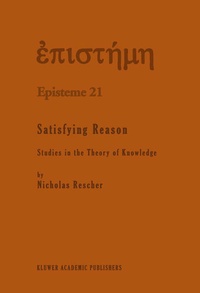
Satisfying Reason
Studies in the Theory of Knowledge
Published on 31. March 1995
Book
Hardback
XII, 246 pages
978-0-7923-3148-3 (ISBN)
Description
Leibniz said with a mixture of admiration and inspiration that the Duchess Sophie of Hannover always wanted to know the reason why behind the reason why. And that is just how rationality works: it wants to leave no loose ends to understanding, seeking to enable us to understand things through to the bitter end.
In the twelve chapters that make up Satisfying Reason , Rescher develops and defends the following perspective:
In the twelve chapters that make up Satisfying Reason , Rescher develops and defends the following perspective:
- That rationality is a cardinal virtue in cognitive matters.
- That this is not something simple and cut-and-dried: in the pursuit of truth through the development of knowledge we face obstacles -- sometimes even insuperable ones.
- All that we can do is the best we can, realizing that even our very best may still be imperfect.
- Nevertheless, the venture is far from hopeless. While absolutes are unattainable in the cognitive venture, some solutions are situationally optimal, being comparatively the best that can be managed under the circumstances.
- That reason itself enables us to come to terms with this state of affairs, urging us to accept the best we can do as good enough.
More details
Series
Edition
1995 ed.
Language
English
Place of publication
Dordrecht
Netherlands
Target group
Professional and scholarly
Research
Illustrations
XII, 246 p.
Dimensions
Height: 241 mm
Width: 160 mm
Thickness: 19 mm
Weight
562 gr
ISBN-13
978-0-7923-3148-3 (9780792331483)
DOI
10.1007/978-94-011-0483-8
Schweitzer Classification
Other editions
Additional editions
E-Book
12/2012
Springer
€139.09
Available for download
Book
10/2012
Springer
€149.79
Shipment within 15-20 days
Content
1: Satisfying Reason.- 2: Why Be Rational?.- 3: Reason and Reality.- 4: Metaknowledge.- 5: Fallibilism and the Pursuit of Truth.- 6: Methodological Optimism.- 7: Meaningless Numbers.- 8: Conceptual Idealism Revisited.- 9: The Contrast Between Explanatory and Experiential Understanding.- 10: The Limits of Cognitive Relativism.- 11 : The Deficits of Deconstructionism.- 12: Exits from Paradox.- Name Index.