

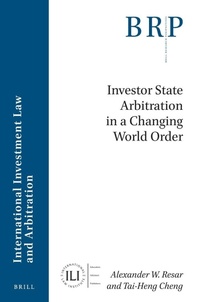
Investor State Arbitration in a Changing World Order
Published on 3. June 2021
Book
Paperback/Softback
96 pages
978-90-04-39058-4 (ISBN)
Description
In Investor State Arbitration In A Changing World Order, the authors examine the sustained worldwide challenges to investor state arbitration arising from across the political spectrum. These challenges have led to extensive and thoughtful proposals for reform from the international arbitration community, domestic lawmakers, and international bureaucrats. These reforms play an important role in the continuous evolution of investor state arbitration, and will enhance the quality of justice rendered.
However, the authors argue, these reforms are insufficient to resolve the domestic political challenges that investor state arbitration faces. Only political solutions that justify for broad populations the international flow of capital and the independent resolution of disputes arising therefrom can preserve the institution of investor state arbitration. Absent the more equitable distribution of the benefits associated with the international flow of capital, political support for investor state arbitration will remain tenuous, notwithstanding the significant de-escalatory benefits investor state arbitration offers.
However, the authors argue, these reforms are insufficient to resolve the domestic political challenges that investor state arbitration faces. Only political solutions that justify for broad populations the international flow of capital and the independent resolution of disputes arising therefrom can preserve the institution of investor state arbitration. Absent the more equitable distribution of the benefits associated with the international flow of capital, political support for investor state arbitration will remain tenuous, notwithstanding the significant de-escalatory benefits investor state arbitration offers.
More details
Series
Language
English
Place of publication
Leiden
Netherlands
Target group
Professional and scholarly
Product notice
Paperback (trade)
Unsewn / adhesive bound
Dimensions
Height: 234 mm
Width: 155 mm
Thickness: 6 mm
Weight
145 gr
ISBN-13
978-90-04-39058-4 (9789004390584)
Copyright in bibliographic data and cover images is held by Nielsen Book Services Limited or by the publishers or by their respective licensors: all rights reserved.
Schweitzer Classification
Persons
Alexander W. Resar, J.D. (2017), Yale Law School, is an associate at Quinn Emanuel Urquhart & Sullivan, LLP. His practice involves litigation and arbitration of international disputes. He has also published articles on international law and United States' public law.
Tai-Heng Cheng, is global Co-Head of International Arbitration and Trade, and Co-Managing Partner (Singapore) of Sidley Austin LLP. Formerly a tenured law professor in the United States, he is the author of four books and over 60 articles, which courts and tribunals have cited and relied on as authoritative.
Tai-Heng Cheng, is global Co-Head of International Arbitration and Trade, and Co-Managing Partner (Singapore) of Sidley Austin LLP. Formerly a tenured law professor in the United States, he is the author of four books and over 60 articles, which courts and tribunals have cited and relied on as authoritative.
Content
Investor State Arbitration in a Changing World Order
?Tai-Heng Cheng & Alexander W. Resar
?Abstract 1
?Keywords
?Preface
?Introduction: The Intertwined Fates of the Liberal Order and Investor-State Arbitration
?Part 1: The Development of Investor-State Arbitration
?Part 2: Contextualizing the Backlash against Investor-State Arbitration
?Part 3: Reforming Investor-State Arbitration
?Conclusion: The Future of Investor State Arbitration
?References
?Tai-Heng Cheng & Alexander W. Resar
?Abstract 1
?Keywords
?Preface
?Introduction: The Intertwined Fates of the Liberal Order and Investor-State Arbitration
?Part 1: The Development of Investor-State Arbitration
?Part 2: Contextualizing the Backlash against Investor-State Arbitration
?Part 3: Reforming Investor-State Arbitration
?Conclusion: The Future of Investor State Arbitration
?References