

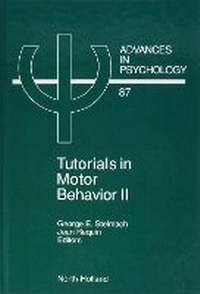
Tutorials in Motor Behavior II: Volume 87
Published on 6. May 1992
Book
Hardback
988 pages
978-0-444-88801-3 (ISBN)
Description
This book appraises the main theoretical ideas currently characteristic of the motor behavior field, bringing together contributions from many internationally known scientists who are doing this important research. Much of the work presented utilizes new recording techniques aimed at obtaining a complete kinematic account of how movement is executed. The motor behavior field as described in this volume is dominated by approaches which emphasize the dynamics and kinematics of movement. There is also an emphasis on new electrophysiological measures. The volume is organized into several sections based on specific themes. Chapters contained in each section discuss many currently debated questions in the field concerning motor mechanisms and their implementation for motor control.
More details
Series
Language
English
Place of publication
United States
Publishing group
Elsevier Science & Technology
Target group
Professional and scholarly
Dimensions
Height: 234 mm
Width: 156 mm
Weight
1440 gr
ISBN-13
978-0-444-88801-3 (9780444888013)
Copyright in bibliographic data and cover images is held by Nielsen Book Services Limited or by the publishers or by their respective licensors: all rights reserved.
Schweitzer Classification
Persons
Content
Models and theories of motor control. Representation and control
of movement. Control and coordination of reaching movements.
Structure and function relationships. Intersegmental dynamics of
movement. Bioelectrical and biomechanical correlates of movement.
Feature coding and selective activation. Anatomical and behavior
contribution to movement.
of movement. Control and coordination of reaching movements.
Structure and function relationships. Intersegmental dynamics of
movement. Bioelectrical and biomechanical correlates of movement.
Feature coding and selective activation. Anatomical and behavior
contribution to movement.