

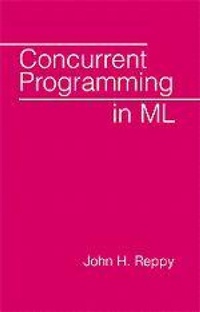
Concurrent Programming in ML
Published on 13. August 1999
Book
Hardback
326 pages
978-0-521-48089-5 (ISBN)
Description
Concurrent Programming in ML focuses on the practical use of concurrency to implement naturally concurrent applications. In addition to a tutorial introduction to programming in Concurrent ML (CML), the book presents three extended examples using CML for practical systems programming: a parallel software build system, a simple concurrent window manager, and an implementation of distributed tuple spaces. CML, which is included as part of the SML of New Jersey (SML/NJ) distribution, combines the best features of concurrent programming and functional programming. This book also illustrates advanced SML programming techniques, and includes a chapter on the implementation of concurrency using features provided by the SML/NJ system. It will be of interest to programmers, students, and professional researchers working in computer language development.
More details
Language
English
Place of publication
Cambridge
United Kingdom
Target group
Professional and scholarly
Illustrations
3 Tables, unspecified; 41 Line drawings, unspecified
Dimensions
Height: 260 mm
Width: 183 mm
Thickness: 22 mm
Weight
810 gr
ISBN-13
978-0-521-48089-5 (9780521480895)
Copyright in bibliographic data and cover images is held by Nielsen Book Services Limited or by the publishers or by their respective licensors: all rights reserved.
Schweitzer Classification
Other editions
Additional editions
John H. Reppy
Concurrent Programming in ML
Book
09/2007
Cambridge University Press
€65.90
Shipment within 15-20 days
Person
Content
1. Introduction; 2. Concepts in concurrent programming; 3. An introduction to Concurrent ML; 4. CML programming techniques; 5. Synchronization and communication mechanisms; 6. The rationale for CML; 7. A software build system; 8. A concurrent window system; 9. A CML implementation of Linda; 10. Implementing concurrency in SML/NJ; Appendix 1. CML reference manual; Appendix 2. The semantics of CML.