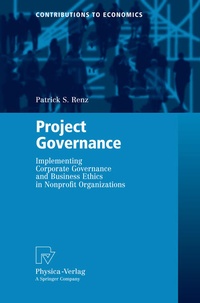
Do you know where your investments go? How effective and accountable are the resources used in the international development? How can intercultural frictions, governance scandals, or corruption be prevented?
Based on a case study the author unveils a gap in the governance of development projects, a gap between implementation and governance, ultimately hindering effective, transparent and accountable usage of resources.
Illustrated with entertaining examples the author, himself a senior manager in development and business, develops a Project Governance model. Overcoming shortcomings of the theories of corporate governance and business ethics, of best practices in development and project management, the Project Governance Model is a concrete model for practitioners and academics. Its six modules build an integrated, strategically oriented and ethically reflected platform for a more truthful and efficient cooperation in difficult projects or programs such as in development.
Reviews / Votes
From the reviews:
"This exploratory study pursues the objective of building a project governance model, as a useful golden mean to overcome the governance gap . . the conceptual framework seems to have been adequately balanced in relation to the objective of harmoniously combining theory and practice. . Renz's project governance model offers us, above all, the opportunity to consider a governance gap and, generally speaking, the opportunity to think about how to enhance and interiorize ethics and accountability in development sectors." (Pasquale Arena, Journal of Management & Governance, Vol. 13, 2009)
Series
Edition
Language
Place of publication
Target group
Professional and scholarly
Professional/practitioner
Illustrations
33 s/w Abbildungen
XVI, 260 p. 33 illus.
Dimensions
Height: 235 mm
Width: 155 mm
Thickness: 16 mm
Weight
ISBN-13
978-3-7908-1926-7 (9783790819267)
DOI
10.1007/978-3-7908-1927-4
Schweitzer Classification
Prof. Dr. Patrick S. Renz studierte Wirtschaftsinformatik und Betriebswirtschaft an der Universität Zürich und promovierte an der Universität St. Gallen zum Thema "Project Governance - What Nonprofit Organizations can learn from Corporate Governance and Business Ethics". Er hat über 20 Jahre internationale Praxiserfahrung, in verschiedenen Führungspositionen bei Procter & Gamble in Europa und Lateinamerika, als CEO von internationalen Informatik- und Beratungsfirmen und als Leiter von Nonprofitorganisationen. Er spricht 6 Sprachen, hat in 10 Ländern gewohnt und in über 40 Ländern gearbeitet. Seit 2006 ist Patrick Renz als Professor und Forschungsprojektleiter tätig. Aktuell ist er Management-Board-Mitglied der FHNW Hochschule für Wirtschaft, verantwortlich für Forschung, Weiterbildung und Dienstleistung. Seine Kompetenzschwerpunkte liegen in den Bereichen Governance, strategisches Management, Leadership, Project Governance, Integritätsmanagement und Entrepreneurship.
Prof. Dr. Bruno Frischherz studierte Germanistik und Philosophie an der Universität Freiburg i.Ü.. Er war rund 10 Jahre tätig als Lektor am Lern- und Forschungszentrum Fremdsprachen der Universität Freiburg und promovierte über den Zweitsprachenerwerb von Asylbewerbern in der Schweiz. Seit mehr als 20 Jahren arbeitet er nun als Dozent und Forscher an der Hochschule Luzern - Wirtschaft. Er ist Master Certified Developmental Consultant des Interdevelopmental Institute (2011) und logotherapeutischer Berater NDS HF des Instituts für Logotherapie und Existenzanalyse in Chur (2021). Zudem ist er Gründer und Geschäftsführer didanet gmbh, Info- und Lerndesign. Seine Kompetenzschwerpunkte liegen in den Bereichen Unternehmensethik, digitale Ethik, Nachhaltigkeitskommunikation, Persönlichkeitsentwicklung und Dialektisches Denken.
Irena Wettstein: Berufsausbildung als Polygrafin/Typografin, 10 Jahre Praxiserfahrung in der Medien- und Kommunikationsbranche, Studium der Betriebswirtschaft an der Hochschule Luzern und der Lessius Hogeschool, Antwerpen mit Vertiefung in Public & Nonprofit Management, Abschlussarbeit im Bereich Unternehmensethik. Zwei Jahre Tätigkeit im Eidgenössischen Departement für auswärtige Angelegenheiten. Aktuell: Leiterin Kommunikation der Stiftung PanEco.
Objectives and approach.- Is there a need for project governance?.- The roles of governance in development projects.- The Project Governance Model.- Conclusions.