

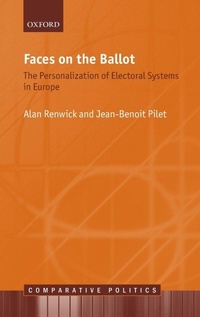
Faces on the Ballot
The Personalization of Electoral Systems in Europe
Published on 4. February 2016
Book
Hardback
354 pages
978-0-19-968504-2 (ISBN)
Description
One of the key shifts in contemporary politics is the trend towards greater personalization. Collective actors such as political parties are losing relevance. Citizens are slowly dealigning from these actors, and individual politicians are therefore growing in importance in elections, in government, within parties, and in media reporting of politics. A crucial question concerns how this new pattern could be restructuring politics over the long run - notably, whether the personalization of politics is changing the institutional architecture of contemporary democracies.
The authors show that the trend towards personalization is indeed changing core democratic institutions. Studying the evolution of electoral systems in thirty-one European democracies since 1945, they demonstrate that, since the 1990s, there has been a shift towards more personalized electoral systems. Electoral systems in most European countries now allow voters to express preferences for candidates, not just for political parties. And the weight of these voters' preferences in the allocation of seats has been increased in numerous countries.
They examine the factors that appear to be driving this evolution, finding that the personalization of electoral systems is associated with the growing gap between citizens and politics. Politicians and legislators appear to perceive the personalization of electoral systems as a way to address the democratic malaise and to restore trust in politics by reducing the role of political parties in elections. The book also shows, however, that whether these reforms have had any success in achieving their aims is far less clear.
Comparative Politics is a series for students, teachers, and researchers of political science that deals with contemporary government and politics. Global in scope, books in the series are characterised by a stress on comparative analysis and strong methodological rigour. The series is published in association with the European Consortium for Political Research. For more information visit: www.ecprnet.eu.
The Comparative Politics series is edited by Emilie van Haute, Professor of Political Science, Universite libre de Bruxelles; Ferdinand Mueller-Rommel, Director of the Center for the Study of Democracy, Leuphana University; and Susan Scarrow, Chair of the Department of Political Science, University of Houston.
The authors show that the trend towards personalization is indeed changing core democratic institutions. Studying the evolution of electoral systems in thirty-one European democracies since 1945, they demonstrate that, since the 1990s, there has been a shift towards more personalized electoral systems. Electoral systems in most European countries now allow voters to express preferences for candidates, not just for political parties. And the weight of these voters' preferences in the allocation of seats has been increased in numerous countries.
They examine the factors that appear to be driving this evolution, finding that the personalization of electoral systems is associated with the growing gap between citizens and politics. Politicians and legislators appear to perceive the personalization of electoral systems as a way to address the democratic malaise and to restore trust in politics by reducing the role of political parties in elections. The book also shows, however, that whether these reforms have had any success in achieving their aims is far less clear.
Comparative Politics is a series for students, teachers, and researchers of political science that deals with contemporary government and politics. Global in scope, books in the series are characterised by a stress on comparative analysis and strong methodological rigour. The series is published in association with the European Consortium for Political Research. For more information visit: www.ecprnet.eu.
The Comparative Politics series is edited by Emilie van Haute, Professor of Political Science, Universite libre de Bruxelles; Ferdinand Mueller-Rommel, Director of the Center for the Study of Democracy, Leuphana University; and Susan Scarrow, Chair of the Department of Political Science, University of Houston.
Reviews / Votes
The key contribution of Faces on the Ballot is to really give us a good sense of how electoral systems have changed in European countries in the post-war period. I think what it shows very clearly which many of us hadnt realised before is how systems have moved towards a more personalised system and away from a more party-based system. * Professor Justin Fisher (Brunel University) * I think there are at least two key contributions of this book. The first is simply as a huge exercise in data gathering and in meticulous documentation of often very subtle, nuanced changes in electoral systems, from which we can start to see a pattern emerging. It has created a huge data resource for future scholars to use. I think the other is showing there has been this tendency towards greater personalisation of electoral system, trying to see the causes of that, and also looking for evidence of the consequences. * Professor Roger Scully (Cardiff University) *More details
Other editions
Additional editions
Alan Renwick | Jean-Benoit Pilet
Faces on the Ballot
The Personalization of Electoral Systems in Europe
E-Book
02/2016
1st Edition
OUP eBook
€54.49
Available for download
Persons
Alan Renwick is Deputy Director of the Constitution Unit in the Department of Political Science at University College London. He was previously Associate Professor of Comparative Politics at the University of Reading. His publications include The Politics of Electoral Reform: Changing the Rules of Democracy (Cambridge University Press, 2010) and A Citizen's Guide to Electoral Reform (Biteback, 2011). His research focuses primarily on processes of electoral and broader political reform and how these are changing over time.
Jean-Benoit Pilet is Professor of Political Science at the Universite Libre de Bruxelles (ULB). He works on electoral systems, elections, institutional reforms and party politics. He has recently co-edited, with William Cross, The Politics of Party Leadership: a Cross-National Perspective (OUP, forthcoming) and is the author of several articles published in journals like Electoral Studies, Party Politics, European Journal of Political Research, West European Politics, Representation and Journal of Elections, and Public Opinion and Parties.
Jean-Benoit Pilet is Professor of Political Science at the Universite Libre de Bruxelles (ULB). He works on electoral systems, elections, institutional reforms and party politics. He has recently co-edited, with William Cross, The Politics of Party Leadership: a Cross-National Perspective (OUP, forthcoming) and is the author of several articles published in journals like Electoral Studies, Party Politics, European Journal of Political Research, West European Politics, Representation and Journal of Elections, and Public Opinion and Parties.
Content
PART 1. ARE ELECTORAL SYSTEMS BECOMING MORE PERSONALIZED?; PART 2. WHAT EXPLAINS ELECTORAL SYSTEM PERSONALIZATION?; PART 3. DO PERSONALIZING ELECTORAL REFORMS HAVE ANY EFFECTS?