

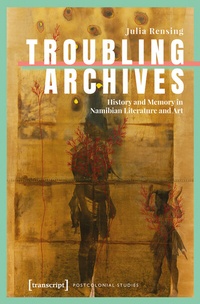
Troubling Archives
History and Memory in Namibian Literature and Art
1st Edition
Published on 30. June 2025
Book
Paperback/Softback
332 pages
978-3-8376-7760-7 (ISBN)
Description
Namibia's colonial history casts a long shadow over the country's present. Contemporary authors and artists confront the legacies of German and South African colonial rule and engage creatively with the persistent remnants of the past. In their works, the archive remains both an invaluable and fraught resource for accessing obscured histories. Julia Rensing examines how writers and artists from Namibia and South Africa navigate archival silences, omissions, and power structures to renegotiate historical narratives and address intergenerational trauma. Their creative practices challenge conventional understandings of archives and forms of commemoration, highlighting the diverse experiences that shape Namibian society and memory cultures.
Reviews / Votes
»This fine-grained exploration of colonial archives, Namibian women's personal narratives, and the transformative engagements with archives by a new generation of artists and authors significantly shifts our way of seeing history and listening to its reverberations. Troubling Archives illuminates multi-perspective approaches to the legacies of truly devastating pasts and traumatic experiences.«More details
Series
Language
English
Place of publication
Germany
Target group
Professional and scholarly
Product notice
Klappenbroschur
Illustrations
73
58 farbige Abbildungen, 15 s/w Abbildungen
Dimensions
Height: 22.5 cm
Width: 14.8 cm
Weight
34 gr
ISBN-13
978-3-8376-7760-7 (9783837677607)
Schweitzer Classification
Other editions
Additional editions
E-Book
05/2025
1st Edition
transcript
€0.00
Available for download
Person
Author
Julia Rensing, Universität Basel, Schweiz
Julia Rensing, geb. 1991, ist Postdoktorandin und Dozentin am Zentrum für Afrikastudien an der Universität Basel. In ihrer Forschung untersucht sie, wie Archive zur alternativen Produktion von Wissen genutzt werden und wie künstlerische Praktiken Diskurse über (De)kolonialität und Erinnerung prägen. Sie ist Mitglied von freiburg-postkolonial.