

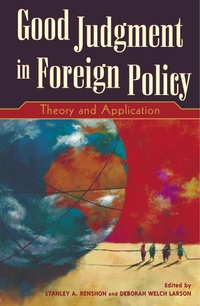
Good Judgment in Foreign Policy
Theory and Application
Published on 27. August 2002
Book
Paperback/Softback
288 pages
978-0-7425-1007-4 (ISBN)
Description
At the heart of political leadership lies choice. And at the heart of choice lies judgment. A leader's psychology and experience intersect with political realities to produce consequences that can make or break a leader-or a country. Nowhere is judgment more important than in the making of foreign policy. Good judgments can avoid wars, or win them. Poor judgments can start wars or lose them. This book draws together a distinguished group of contributors-psychologists, political scientists, and policymakers-to focus on and understand both good and poor judgment in foreign policy making. Case studies of key leadership decisions combine with theoretical overviews and analyses to offer a highly textured portrait of judgment in action in the all-important foreign policy arena. An up-to-the-minute case on George W. Bush and the war on terrorism applies good judgment theory to contemporary events.
Reviews / Votes
Contributes to the elucidation of the mystery of foreign policy analysis and its change in the post-Cold War era. * International Affairs *More details
Language
English
Place of publication
United States
Publishing group
Bloomsbury Publishing Plc
Target group
College/higher education
Professional and scholarly
Product notice
Paperback (trade)
Dimensions
Height: 230 mm
Width: 156 mm
Thickness: 20 mm
Weight
458 gr
ISBN-13
978-0-7425-1007-4 (9780742510074)
Copyright in bibliographic data and cover images is held by Nielsen Book Services Limited or by the publishers or by their respective licensors: all rights reserved.
Schweitzer Classification
Other editions
Additional editions
E-Book
08/2002
1st Edition
Rowman & Littlefield
€49.99
Available for download
Persons
Stanley A. Renshon is professor of political science and coordinator of the Interdisciplinary Program in the Psychology of Social and Political Behavior at the City University of New York Graduate Center. Deborah Welch Larson is professor of political science at University of California, Los Angeles.
Content
Part 1 I The Nature of Good Judgment Chapter 2 Good Judgment in Foreign Policy: Social Psychological Perspectives Chapter 2 Psychological Sources of Good Judgment in Political Leaders: A Framework for Analysis Part 4 II The Dynamics of Good Judgment: Appraisals and Images Chapter 5 Appraising Good Judgment Before It Matters: Al Gore, George W. Bush and the 2000 Election Campaign Chapter 6 Bad Guys and Bad Judgments Part 7 III Judgments and Misjudgments in Foregin Policy Decisions Chapter 8 Truman and the Berlin Blockade: The Role of Intuition and Experience in Good Foreign Policy Judgment Chapter 9 Perceiving the End of Threat: Ronald Reagan and the Gorbachev Revolution Chapter 10 Culture and Emotion as Obstacles to Good Judgment: The Case of Argentina's Invasion of the Falklands/Malvinas Part 11 IV Improving the Quality of Judgment in Foreign Policy Decision Making Chapter 12 Policy Planning: Oxymoron or Sine Qua Non for U.S. Foreign Policy? Chapter 13 Why Foreign Policy (When It Comes to Judgment, at Least) is Not Pornography Chapter 14 Analysis and Judgment in Policymaking Part 15 V Reflections on Good Judgment in a Dangerous World Chapter 16 The World According to George W. Bush: Good Judgment or Cowboy Politics? Chapter 17 Politics, Uncertainty, and Values: Good Judgment in Context