

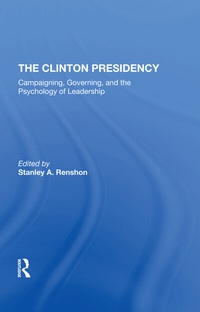
The Clinton Presidency
Campaigning, Governing, And The Psychology Of Leadership
1st Edition
Published on 7. May 2019
Book
Hardback
261 pages
978-0-367-29090-0 (ISBN)
Description
The Clinton presidency faced a basic set of public questions at the outset regarding its real intentions, strategies, and competence. Would the administration be able to develop and implement policies that were constructive in intent, fair in formulation, and successful in result? Would President Clinton be able to govern as successfully as he campaigned? Would there be a productive fit between Clinton's leadership style and the needs of the public? Additional questions arise about Clinton personally. Many admire him; others distrust him. What realistic basis is there for either view? This book explores these questions and develops an initial appraisal of the Clinton presidency. The chapters herein are framed by theories of political leadership and psychology. They draw on a diverse body of theories, including psychological theories of character and personality, cognitive psychology and communication theory, theories of presidential leadership and performance, and theories of public psychology. The goal is to examine the many facets of leadership and governing that constitute the modern presidency and to locate Bill Clinton's emerging presidency within that framework. Bill Clinton is and likely will remain a controversial president. One objective of this analysis is to provide a clearer, more objective framework in which to evaluate both the man and his approach to political leadership and executive power and the consequences of his approach for public psychology and policy.
More details
Language
English
Place of publication
London
United Kingdom
Publishing group
Taylor & Francis Ltd
Target group
College/higher education
Dimensions
Height: 229 mm
Width: 152 mm
Weight
660 gr
ISBN-13
978-0-367-29090-0 (9780367290900)
Copyright in bibliographic data and cover images is held by Nielsen Book Services Limited or by the publishers or by their respective licensors: all rights reserved.
Schweitzer Classification
Other editions
Additional editions
Book
11/2020
1st Edition
Routledge
€52.07
Shipment within 15-20 days
E-Book
06/2019
1st Edition
Routledge
€59.49
Available for download
E-Book
06/2019
1st Edition
Routledge
€59.49
Available for download
Person
Stanley A. Renshon is a professor of political science at the City University of New York and a psychoanalyst and clinical faculty member at the Training and Research Institute for Self Psychology. He is the editor of the journal Political Psychology. His most recent book is The Political Psychology of the Gulf War: Leaders, Publics and the Process of Conflict.
Content
Preface -- The Psychological Context of the Clinton Presidency: A Framework for Analysis -- Presidential Psychology-The 1992 Campaign: What Did We Learn? -- How George Bush Lost the Presidential Election of 1992 -- The Political Psychology of the Ross Perot Phenomenon -- Character, Judgment, and Political Leadership: Promise, Problems, and Prospects of the Clinton Presidency -- Public Psychology-Leadership Style -- The Cueless Public: Bill Clinton Meets the New American Voter in Campaign '92 -- Presidential Psychology and Governing Styles: A Comparative Psychological Analysis of the 1992 Presidential Candidates -- The Process of Presidential Leadership -- Political Style and Political Leadership: The Case of Bill Clinton -- Advice and Advisers in the Clinton Presidency: The Impact of Leadership Style -- Public Psychology and President Clinton -- President Clinton Meets the Media: Communications Shaped by Predictable Patterns -- Public Opinion in President Clinton's First Year: Leadership and Responsiveness -- The Clinton Presidency and the Psychology of Public Policy: Dilemmas and Opportunities -- President Clinton as a Cognitive Manager -- Psychological Dimensions of Post-Cold War Foreign Policy