

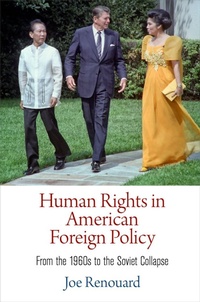
Human Rights in American Foreign Policy
From the 196s to the Soviet Collapse
Will be published approx. on 4. December 2015
Book
Hardback
336 pages
978-0-8122-4773-2 (ISBN)
Description
International human rights issues perpetually highlight the tension between political interest and idealism. Over the last fifty years, the United States has labored to find an appropriate response to each new human rights crisis, balancing national and global interests as well as political and humanitarian impulses.
Human Rights in American Foreign Policy explores America's international human rights policies from the Vietnam War era to the end of the Cold War. Global in scope and ambitious in scale, this book examines American responses to a broad array of human rights violations: torture and political imprisonment in South America; apartheid in South Africa; state violence in China; civil wars in Central America; persecution of Jews in the Soviet Union; movements for democracy and civil liberties in East Asia and Eastern Europe; and revolutionary political transitions in Iran, Nicaragua, and the collapsing USSR.
Joe Renouard challenges the characterization of American human rights policymaking as one of inaction, hypocrisy, and double standards. Arguing that a consistent standard is impractical, he explores how policymakers and citizens have weighed the narrow pursuit of traditional national interests with the desire to promote human rights. Human Rights in American Foreign Policy renders coherent a series of disparate foreign policy decisions during a tumultuous time in world history. Ultimately the United States emerges as neither exceptionally compassionate nor unusually wicked. Rather, it is a nation that manages by turns to be cautiously pragmatic, boldly benevolent, and coldly self-interested.
Human Rights in American Foreign Policy explores America's international human rights policies from the Vietnam War era to the end of the Cold War. Global in scope and ambitious in scale, this book examines American responses to a broad array of human rights violations: torture and political imprisonment in South America; apartheid in South Africa; state violence in China; civil wars in Central America; persecution of Jews in the Soviet Union; movements for democracy and civil liberties in East Asia and Eastern Europe; and revolutionary political transitions in Iran, Nicaragua, and the collapsing USSR.
Joe Renouard challenges the characterization of American human rights policymaking as one of inaction, hypocrisy, and double standards. Arguing that a consistent standard is impractical, he explores how policymakers and citizens have weighed the narrow pursuit of traditional national interests with the desire to promote human rights. Human Rights in American Foreign Policy renders coherent a series of disparate foreign policy decisions during a tumultuous time in world history. Ultimately the United States emerges as neither exceptionally compassionate nor unusually wicked. Rather, it is a nation that manages by turns to be cautiously pragmatic, boldly benevolent, and coldly self-interested.
More details
Series
Language
English
Place of publication
Pennsylvania
United States
Target group
College/higher education
Product notice
Paper over boards
Illustrations
1 illus.
Dimensions
Height: 231 mm
Width: 155 mm
Thickness: 25 mm
Weight
612 gr
ISBN-13
978-0-8122-4773-2 (9780812247732)
Copyright in bibliographic data and cover images is held by Nielsen Book Services Limited or by the publishers or by their respective licensors: all rights reserved.
Schweitzer Classification
Other editions
Additional editions
E-Book
10/2015
1st Edition
University of Pennsylvania Press
€88.49
Available for download
Person
Joe Renouard teaches history at The Citadel and at the Johns Hopkins University's School of Advanced International Studies in Nanjing, China. He is author of The Ties That Bind: The History of Sutherland, Asbill, and Brennan.