

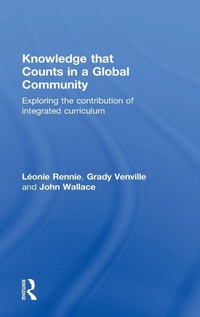
Knowledge that Counts in a Global Community
Exploring the Contribution of Integrated Curriculum
1st Edition
Published on 28. October 2011
Book
Hardback
160 pages
978-0-415-57337-5 (ISBN)
Description
As the third millennium progresses, we are faced with increasing pressures relating to climate change and the sustainability of life on Earth. Concerned citizens are realizing that the responsibility to respond is both local and global. There is an increasing sense of urgency about the need to reform the processes of schooling and curriculum to better prepare students for global citizenship. Educators, policy makers and the wider community are seeking information about how to proceed with this reform effort, particularly how alternative and integrated approaches to curriculum can be used to engage students with the important issues of our time.
Knowledge that Counts in a Global Community explores the potential contribution of curriculum integration in a context where school curricula are typically segregated by discipline. It offers curriculum integration as a powerful tool for educating young citizens so that they can understand and respond to global concerns. It argues for an informed citizenry who can think broadly across disciplines, and contribute sensibly and pragmatically to local problems with an eye on how this translates to making a global difference. In its examination of the twin themes of global knowledge and curriculum integration, the book explores:
the nature of curriculum integration
the nature of knowledge
the nature of learning
The authors reflect on these issues from perspectives gained by more than a decade of research in the area. Their in-depth, scholarly exploration and critical analysis of current approaches to curriculum, introduces educators and academics to contemporary ways of conceptualizing the complexities of, and relationships among curriculum integration, knowledge and learning. Throughout the book, the authors emphasize the central curriculum question, what kinds of outcomes do we want for students of the twenty-first century?
This book will provide a valuable resource for academic educators, researchers, teachers and others interested in educational policy reform.
Knowledge that Counts in a Global Community explores the potential contribution of curriculum integration in a context where school curricula are typically segregated by discipline. It offers curriculum integration as a powerful tool for educating young citizens so that they can understand and respond to global concerns. It argues for an informed citizenry who can think broadly across disciplines, and contribute sensibly and pragmatically to local problems with an eye on how this translates to making a global difference. In its examination of the twin themes of global knowledge and curriculum integration, the book explores:
the nature of curriculum integration
the nature of knowledge
the nature of learning
The authors reflect on these issues from perspectives gained by more than a decade of research in the area. Their in-depth, scholarly exploration and critical analysis of current approaches to curriculum, introduces educators and academics to contemporary ways of conceptualizing the complexities of, and relationships among curriculum integration, knowledge and learning. Throughout the book, the authors emphasize the central curriculum question, what kinds of outcomes do we want for students of the twenty-first century?
This book will provide a valuable resource for academic educators, researchers, teachers and others interested in educational policy reform.
More details
Language
English
Place of publication
London
United Kingdom
Publishing group
Taylor & Francis Ltd
Target group
College/higher education
Product notice
Paper over boards
Illustrations
6 s/w Tabellen
6 Tables, black and white
Dimensions
Height: 240 mm
Width: 161 mm
Thickness: 13 mm
Weight
411 gr
ISBN-13
978-0-415-57337-5 (9780415573375)
Copyright in bibliographic data and cover images is held by Nielsen Book Services Limited or by the publishers or by their respective licensors: all rights reserved.
Schweitzer Classification
Other editions
Additional editions
Leonie J. Rennie | Grady Venville | John Wallace
Knowledge that Counts in a Global Community
Exploring the Contribution of Integrated Curriculum
Book
07/2017
1st Edition
Routledge
€68.80
Shipment within 15-20 days
Leonie J. Rennie | Grady Venville | John Wallace
Knowledge that Counts in a Global Community
Exploring the Contribution of Integrated Curriculum
E-Book
03/2013
1st Edition
Routledge
€62.99
Available for download
Leonie J. Rennie | Grady Venville | John Wallace
Knowledge that Counts in a Global Community
Exploring the Contribution of Integrated Curriculum
E-Book
03/2013
1st Edition
Routledge
€63.49
Available for download
Persons
Leonie Rennie is a Research Professor in the Office of Research and Development at Curtin University of Technology in Perth, Western Australia.
Grady Venville is a Professor in the Graduate School of Education at the University of Western Australia in Perth, Western Australia.
John Wallace is a Professor at the Ontario Institute for Studies in Education at the University of Toronto, Canada.
Grady Venville is a Professor in the Graduate School of Education at the University of Western Australia in Perth, Western Australia.
John Wallace is a Professor at the Ontario Institute for Studies in Education at the University of Toronto, Canada.
Content
1. Introduction: Mapping the Territory 2. The Structure and Status of Knowledge 3. The Nature of Integrated Curricula 4. Implementation of Integrated Curricula 5.Perspectives on Learning in Integrated Contexts 6. Looking Ahead: Power, Knowledge and Curriculum