

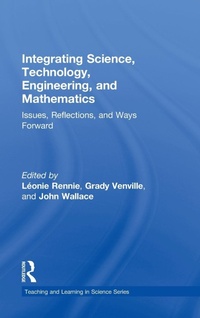
Integrating Science, Technology, Engineering, and Mathematics
Issues, Reflections, and Ways Forward
1st Edition
Published on 11. May 2012
Book
Hardback
160 pages
978-0-415-89756-3 (ISBN)
Description
How can curriculum integration of school science with the related disciplines of technology, engineering and mathematics (STEM) enhance students' skills and their ability to link what they learn in school with the world outside the classroom?
Featuring actual case studies of teachers' attempts to integrate their curriculum, their reasons for doing so, how they did it, and their reflections on the outcomes, this book encourages science educators to consider the purposes and potential outcomes of this approach and raises important questions about the place of science in the school curriculum. It takes an honest approach to real issues that arise in curriculum integration in a range of education contexts at the elementary and middle school levels. The clear documentation and critical analysis of the contribution of science in curriculum integration-its implementation and its strengths and weaknesses-will assist teachers, science educators, and researchers to understand how this approach can work to engage students and improve their learning, as well as how it does not happen easily, and how various factors can facilitate or hinder successful integration.
Featuring actual case studies of teachers' attempts to integrate their curriculum, their reasons for doing so, how they did it, and their reflections on the outcomes, this book encourages science educators to consider the purposes and potential outcomes of this approach and raises important questions about the place of science in the school curriculum. It takes an honest approach to real issues that arise in curriculum integration in a range of education contexts at the elementary and middle school levels. The clear documentation and critical analysis of the contribution of science in curriculum integration-its implementation and its strengths and weaknesses-will assist teachers, science educators, and researchers to understand how this approach can work to engage students and improve their learning, as well as how it does not happen easily, and how various factors can facilitate or hinder successful integration.
Reviews / Votes
"This series of case studies is valuable for educators and teacher educators in STEM fields." -Teachers College RecordMore details
Series
Language
English
Place of publication
London
United Kingdom
Publishing group
Taylor & Francis Ltd
Target group
College/higher education
Illustrations
9 s/w Tabellen
9 Tables, black and white
Dimensions
Height: 235 mm
Width: 157 mm
Thickness: 13 mm
Weight
392 gr
ISBN-13
978-0-415-89756-3 (9780415897563)
Copyright in bibliographic data and cover images is held by Nielsen Book Services Limited or by the publishers or by their respective licensors: all rights reserved.
Schweitzer Classification
Other editions
Additional editions
Leonie Rennie | Grady Venville | John Wallace
Integrating Science, Technology, Engineering, and Mathematics
Issues, Reflections, and Ways Forward
E-Book
05/2012
1st Edition
Routledge
€59.49
Available for download
Leonie Rennie | Grady Venville | John Wallace
Integrating Science, Technology, Engineering, and Mathematics
Issues, Reflections, and Ways Forward
E-Book
05/2012
1st Edition
Routledge
€59.49
Available for download

Leonie Rennie | Grady Venville | John Wallace
Integrating Science, Technology, Engineering, and Mathematics
Issues, Reflections, and Ways Forward
Book
05/2012
1st Edition
Routledge
€65.10
Shipment within 15-20 days
Persons
Leonie Rennie is a Professor in the Science and Mathematics Education Centre at Curtin University in Western Australia.
Grady Venville is Professor of Science Education, Graduate School of Education, University of Western Australia.
John Wallace is a Professor at the Ontario Institute for Studies in Education, University of Toronto.
Grady Venville is Professor of Science Education, Graduate School of Education, University of Western Australia.
John Wallace is a Professor at the Ontario Institute for Studies in Education, University of Toronto.
Content
1. Exploring curriculum integration: Why integrate? Leonie Rennie, John Wallace, and Grady Venville 2. Focus on learning: Building rockets and submarines at Leaside High School Fiona Budgen 3. Focus on problem-solving: Modeling an ice hockey rink at Greenwich Public School Sheryl MacMath 4. Focus on engineering: Bridge building at Southern High School Grady Venville 5. Focus on literacy: Linking language and horticulture at Seaview Community School Susan Joan Gribble and Leonie Rennie 6. Focus on reinforcement: Exploring electricity and energy use at Beachville High School Sheryl MacMath 7. Focus on focus: Making and marketing a toy at Rinkview Public School John Wallace 8. Focus on teacher support: Considering access for the disabled at Gosport Community School Rachel Sheffield 9. Focus on leadership: Constructing a model house at Mossburn School Rachel Sheffield 10. Focus on community: Learning about tiger snakes at Chelsea Elementary School Rekha B. Koul and Rosemary Sian Evans 11. Focus on values: Investigating water quality in a local lake at Kentish Middle School Grady Venville 12. Reflecting on curriculum integration: Seeking balance and connection through a Worldly Perspective Leonie Rennie, Grady Venville, and John Wallace