

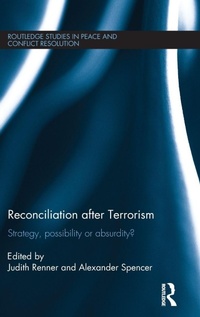
Reconciliation after Terrorism
Strategy, possibility or absurdity?
1st Edition
Published on 4. November 2011
Book
Hardback
248 pages
978-0-415-58858-4 (ISBN)
Description
Reconciliation after Terrorism brings together scholars from the hitherto disparate fields of terrorism and reconciliation studies, in order to examine whether reconciliation is a possible strategy for dealing with and ending a terrorist conflict.
Although terrorist activities often play a role in situations of conflict and transition, terrorists are generally not taken into consideration as active participants by researchers and practitioners. In some cases, the terrorists turn into political actors during the reconciliation process and their past is not an issue anymore, as it was the case with the ANC in South Africa. This book examines the notion of reconciliation with terrorists from a theoretical and empirical perspective.
The notion of engagement and reconciliation with terrorist groups is generally seen as problematic, if not impossible. This is somewhat surprising, given that the idea of societal reconciliation has become a common response to state terror- although not usually in situations of conflict with sub-state terrorist actors. Similar to state terror, sub-state terrorism is a sign of a deep societal rift which reconciliation measures may help to overcome. The text investigates the reconciliatory process further, raising the central questions: (a) what constitutes 'reconciliation' as a process and an outcome; and (b) how can reconciliation be facilitated in a situation of social conflict.
This book will be of much interest to students of terrorism studies, transitional justice, conflict resolution, peace and conflict studies and IR in general.
* * *Reconciliation after Terrorism was featured in the Terrorism Bookshelf: Top 150 Books on Terrorism and Counterterrorism, selected and reviewed by Joshua Sinai. -Perspectives on Terrorism , Vol. 6, No 2, 2012* * *
Although terrorist activities often play a role in situations of conflict and transition, terrorists are generally not taken into consideration as active participants by researchers and practitioners. In some cases, the terrorists turn into political actors during the reconciliation process and their past is not an issue anymore, as it was the case with the ANC in South Africa. This book examines the notion of reconciliation with terrorists from a theoretical and empirical perspective.
The notion of engagement and reconciliation with terrorist groups is generally seen as problematic, if not impossible. This is somewhat surprising, given that the idea of societal reconciliation has become a common response to state terror- although not usually in situations of conflict with sub-state terrorist actors. Similar to state terror, sub-state terrorism is a sign of a deep societal rift which reconciliation measures may help to overcome. The text investigates the reconciliatory process further, raising the central questions: (a) what constitutes 'reconciliation' as a process and an outcome; and (b) how can reconciliation be facilitated in a situation of social conflict.
This book will be of much interest to students of terrorism studies, transitional justice, conflict resolution, peace and conflict studies and IR in general.
* * *Reconciliation after Terrorism was featured in the Terrorism Bookshelf: Top 150 Books on Terrorism and Counterterrorism, selected and reviewed by Joshua Sinai. -Perspectives on Terrorism , Vol. 6, No 2, 2012* * *
Reviews / Votes
'The density of the contributions, the quality and detail of the research involved and the competence of their authors alone turn this book into a very recommendable read for anybody interested in the issue.' - Georg Grote, Europaeisches Journal fuer Minderheitenfragen, Vol. 5, No. 2, 2012More details
Series
Language
English
Place of publication
London
United Kingdom
Publishing group
Taylor & Francis Ltd
Target group
College/higher education
Professional and scholarly
Illustrations
4 s/w Abbildungen, 3 s/w Tabellen
3 Tables, black and white; 4 Illustrations, black and white
Dimensions
Height: 240 mm
Width: 161 mm
Thickness: 18 mm
Weight
543 gr
ISBN-13
978-0-415-58858-4 (9780415588584)
Copyright in bibliographic data and cover images is held by Nielsen Book Services Limited or by the publishers or by their respective licensors: all rights reserved.
Schweitzer Classification
Other editions
Additional editions
Book
10/2013
1st Edition
Routledge
€71.40
Shipment within 15-20 days
E-Book
03/2012
1st Edition
Routledge
€64.49
Available for download
E-Book
03/2012
1st Edition
Routledge
€64.49
Available for download
Persons
Judith Renner is a Research Fellow at the Ludwig-Maximilians University, Munich, Germany.
Alexander Spencer is an Assistant Professor at the Ludwig-Maximilians University, Munich, Germany.
Alexander Spencer is an Assistant Professor at the Ludwig-Maximilians University, Munich, Germany.
Content
Introduction: Reconciling the Seemingly Irreconcilable? Part I: Theoretical Reflections on Reconciliation after Terrorism 1. Orthodox Terrorism Theory and Reconciliation: The Transition out of Terrorism 2. Marginalizing 'Victims' and 'Terrorists': Modes of Exclusion in the Reconciliation Process Part II: Empirical Case Studies of Reconciliation in Terrorist Conflicts 3. Reconciliation following Terrorism in South Tyrol: A Successful Story of Peacemaking by Consociational Democracy and Power-Sharing 4. Reconciliation and Paramilitaries in Nothern Ireland 5. Reconciliation with 'Terrorists': Understanding the Legacy of Terror in South Africa 6. Overcoming Terrorism in Peru without Negotiation or Reconciliation 7. Undermining Reconciliation: Colombian Peace Spoilers in- and outside the Negotiation Process 8. Talking: A Potential Path to Reconciliation in Mindanao 9. Terror, Empathy and Reconciliation in the Israeli-Palestinian Conflict 10. Conclusion: The (im)Possibility of Reconciliation in Afghanistan and the 'War on Terror'