

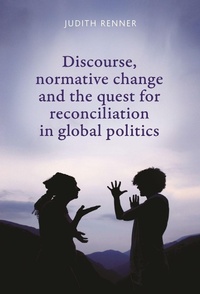
Discourse, Normative Change and the Quest for Reconciliation in Global Politics
Will be published approx. on 1. March 2013
Book
Hardback
208 pages
978-0-7190-8802-5 (ISBN)
Description
This book offers a new and critical perspective on the global reconciliation technology by highlighting its contingent and highly political character as an authoritative practice of post-conflict peacebuilding. After retracing the emergence of the reconciliation discourse from South Africa to the global level, the book demonstrates how implementing reconciliation in post-conflict societies is a highly political practice which entails potentially undesirable consequences for the post-conflict societies to which it is deployed. Specifically, the book shows how the reconciliation discourse brings about the marginalisation and neutralisation of political claims and identities of local post-conflict populations by producing these societies as being composed of the 'victims' and 'perpetrators' of past human rights violations which are first and foremost in need of reconciliation and healing.
This book will interest students and teachers of transitional justice and international relations. -- .
This book will interest students and teachers of transitional justice and international relations. -- .
Reviews / Votes
Judith Renner's book is an excellent combination of empirical analysis and theoretical reflection which enhances not only our understanding of the global rise of the reconciliation discourse, but also illuminates the theoretical problem of normative change in international politics.|A superb, analytically sharp and yet eminently readable treatment of the rise of the concept of reconciliation in international politics. This is a piece of work that will change the way we view reconciliation as a device in post-conflict situations.|This book is a must-have for anyone who doubts that discourse analysis has something to offer to our understanding of society. It demonstrates how reconciliation as a recipe and truth and reconciliation commissions as a technique could become hegemonic concepts in the global discourse on how societies should deal with atrocities they committed or suffered in the past. A truly fascinating endeavor! -- .More details
Language
English
Place of publication
Manchester
United Kingdom
Target group
College/higher education
Professional and scholarly
Product notice
Unsewn / adhesive bound
Paper over boards
Illustrations
Line drawings, black & white
Dimensions
Height: 236 mm
Width: 155 mm
Thickness: 23 mm
Weight
476 gr
ISBN-13
978-0-7190-8802-5 (9780719088025)
Copyright in bibliographic data and cover images is held by Nielsen Book Services Limited or by the publishers or by their respective licensors: all rights reserved.
Schweitzer Classification
Other editions
Additional editions
E-Book
02/2018
1st Edition
Manchester University Press
from
€42.99
Available for download
Person
Judith Renner is Assistant Professor in Political Science at the Technical University Munich -- .
Content
List of figures
Acknowledgements
List of abbreviations
Introduction
1. A discourse theoretical approach to normative change
2. The emergence of reconciliation as an empty universal in South Africa
3. The global proliferation of the reconciliation language in the context of the transitional justice discourse
4.The proliferation of reconciliation practices and the rise of a global reconciliation coalition
5. Bringing reconciliation to Sierra Leone: the global reconciliation discourse and its local performance
Conclusion -- .
Acknowledgements
List of abbreviations
Introduction
1. A discourse theoretical approach to normative change
2. The emergence of reconciliation as an empty universal in South Africa
3. The global proliferation of the reconciliation language in the context of the transitional justice discourse
4.The proliferation of reconciliation practices and the rise of a global reconciliation coalition
5. Bringing reconciliation to Sierra Leone: the global reconciliation discourse and its local performance
Conclusion -- .