

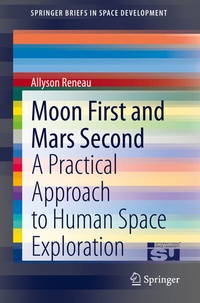
Moon First and Mars Second
A Practical Approach to Human Space Exploration
Published on 10. November 2020
Book
Paperback/Softback
XVII, 104 pages
978-3-030-54229-0 (ISBN)
Description
This SpringerBrief explores the technological, economic, physiological, and psychological comparisons between a journey to the Moon versus a journey to Mars, taking into consideration the national and international perspectives at play. The author spent over six years interviewing leading space experts from around the world to learn why lunar habitats and the creation of a permanent presence on the Moon are an essential next step to human exploration and settlement in space. Practical reasons related to energy, telecommunications and networking, robotic systems, medical and scientific research, material processing, and more show why it must be the Moon First and Mars Second. These findings and recommendations have been adopted by current NASA Administrator Jim Bridenstine, as well as the current U. S. president. The research in this text reflects the author's experiences working internally within NASA Headquarters, the FAA Commercial Spaceflight Office, as well as the International Space University. It is partially based on Reneau's award-winning Harvard thesis in conjunction with her Master's in International Relations.
More details
Product info
Book
Series
Edition
1st ed. 2021
Language
English
Place of publication
Cham
Switzerland
Publishing group
Springer International Publishing
Target group
Professional and scholarly
Illustrations
31
5 s/w Abbildungen, 31 farbige Abbildungen
31 Illustrations, color; 5 Illustrations, black and white; XVII, 104 p. 36 illus., 31 illus. in color.
Dimensions
Height: 235 mm
Width: 155 mm
Thickness: 8 mm
Weight
201 gr
ISBN-13
978-3-030-54229-0 (9783030542290)
DOI
10.1007/978-3-030-54230-6
Schweitzer Classification
Other editions
Additional editions
E-Book
11/2020
Springer
€64.19
Available for download
Person
Allyson was a graduate of the NASA-sponsored International Space University in Montreal, and was asked to teach space entrepreneurship for the ISU for several years. She has held internships at NASA Headquarters in Washington, DC, the FAA Commercial Spaceflight Office, and the Naval War College in Newport, Rhode Island. Her award-winning Harvard thesis has been published and referred to as a framework for our current US Space Policy.
Allyson has been in high demand internationally to advise space-emerging nations on the importance of a national space program, speaking with Presidents, as well as members of their cabinet. Her passion to elevate the educational levels of women and children motivates her deeply.
Allyson Reneau is a successful business owner and is coach of Olympic hopefuls in the sport of gymnastics. In pursuit of a lifelong dream, Allyson graduated summa cum laude from Harvard with a Masters in International Relations. She was recently nominated as Harvard's 2018 Emerging Leader of the Year. Allyson enjoys running, jumping horses, flying, skiing and golfing, and has held her pilot's license for over 35 years. She has been featured on the NBC's Today Show, ABC, CBS, NBC, FOX, and countless magazines, radio shows, and newspapers.
Content
Chapter 1: introduction and the importance of Focusing on the Moon.- Chapter 2: Understanding the Options for Human Exploration and Ultimate Colonization.- Chapter 3: The Advantages of the Moon in terms of Transportation, Fuel Expenditures, Access to Water, and Expense.- Chapter 4: The Advantages of the Moon in terms of Telecommunications and IT Services.- Chapter 5: The Advantages of the Moon in the Context of Near Instantaneous Support Services from Earth.- Chapter 6: Financial, Technical, Utility Infrastructure feasibility to creating a Lunar Colony/ Habitat versus doing so on Mars.- Chapter 7: Examining New Capabilities that could be Created and Tested on the Moon before seeking a Permanent Mars Presence.- Chapter 8: Planning for the Future.- Chapter 9: Conclusions and Next Steps.- Appendix 1: Key Terms and Concepts.- Appendix 2: Space Policy Directive 1.- About the Author.- Index.