

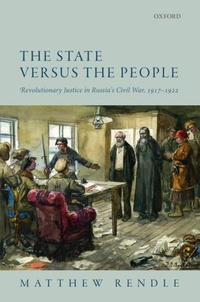
The State versus the People
Revolutionary Justice in Russia's Civil War, 1917-1922
Published on 11. August 2020
Book
Hardback
334 pages
978-0-19-884042-8 (ISBN)
Description
The State versus The People provides the first detailed account of the role of revolutionary justice in the early Soviet state. Law has often been dismissed by historians as either unimportant after the October Revolution amid the violence and chaos of civil war, or, in the absence of written codes and independent judges, little more than another means of violence alongside the secret police (Cheka). This is particularly true of the most revolutionary aspect of the new justice system, revolutionary tribunals--courts inspired by the French Revolution and established to target counter-revolutionary enemies.
Yet the evidence put forward in this book paints a more complex picture. The Bolsheviks invested a great deal of effort and scarce resources in building an extensive system of tribunals that spread across the country and operated within the military and the transport network. At their peak, hundreds of tribunals heard hundreds of thousands of cases every year. Not all, though, ended in harsh sentences: some were dismissed through lack of evidence; others given a wide range of sentences; and others still, suspended sentences. Instances of early release and amnesty were also common.
This book argues that law played a distinct and multi-faceted role for the Bolsheviks. Tribunals, in particular, stood at the intersection between law and violence, offering various advantages to the Bolsheviks by strengthening state control, providing a more effective means of educating the population about counter-revolution, and enabling a more flexible approach to punishing the state's enemies. All of this challenges traditional understandings of the early Soviet state, adding to our knowledge of the civil war and, ultimately, how the Bolsheviks held on to power.
Yet the evidence put forward in this book paints a more complex picture. The Bolsheviks invested a great deal of effort and scarce resources in building an extensive system of tribunals that spread across the country and operated within the military and the transport network. At their peak, hundreds of tribunals heard hundreds of thousands of cases every year. Not all, though, ended in harsh sentences: some were dismissed through lack of evidence; others given a wide range of sentences; and others still, suspended sentences. Instances of early release and amnesty were also common.
This book argues that law played a distinct and multi-faceted role for the Bolsheviks. Tribunals, in particular, stood at the intersection between law and violence, offering various advantages to the Bolsheviks by strengthening state control, providing a more effective means of educating the population about counter-revolution, and enabling a more flexible approach to punishing the state's enemies. All of this challenges traditional understandings of the early Soviet state, adding to our knowledge of the civil war and, ultimately, how the Bolsheviks held on to power.
Reviews / Votes
This clearly written work by Rendle is based on thorough archival research. * W. G. Moss, CHOICE *More details
Language
English
Place of publication
Oxford
United Kingdom
Target group
Professional and scholarly
Product notice
sewn/stitched
Cloth over boards
Dimensions
Height: 239 mm
Width: 155 mm
Thickness: 25 mm
Weight
680 gr
ISBN-13
978-0-19-884042-8 (9780198840428)
Copyright in bibliographic data and cover images is held by Nielsen Book Services Limited or by the publishers or by their respective licensors: all rights reserved.
Schweitzer Classification
Other editions
Additional editions
E-Book
06/2020
1st Edition
OUP eBook
€49.99
Available for download
E-Book
06/2020
1st Edition
OUP eBook
€56.99
Available for download
Person
Matthew Rendle is Senior Lecturer in History at the University of Exeter. He has published numerous articles on various aspects of revolutionary Russia and is the author of Defenders of the Motherland: The Tsarist Elite in Revolutionary Russia (Oxford University Press, 2010), the co-editor of the journal, Revolutionary Russia, and a series editor for the BASEES / Routledge Series on Russian and East European Studies.
Content
Introduction
1: Creating Revolutionary Justice
2: Extending State Authority
3: Categorizing Counter-Revolution
4: The Trial
5: The Logic of Mercy
6: Publicizing Revolutionary Justice
Conclusion
1: Creating Revolutionary Justice
2: Extending State Authority
3: Categorizing Counter-Revolution
4: The Trial
5: The Logic of Mercy
6: Publicizing Revolutionary Justice
Conclusion