

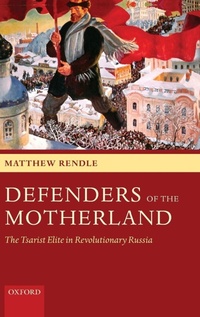
Defenders of the Motherland
The Tsarist Elite in Revolutionary Russia
Published on 5. November 2009
Book
Hardback
288 pages
978-0-19-923625-1 (ISBN)
Description
Defenders of the Motherland studies how the most powerful social groups in tsarist Russia reacted to the challenges posed by the Russian Revolutions of 1917. Arguing that elite groups-especially nobles, landowners, and officers-played an important role in these events, Matthew Rendle shows how the alienation of tsarist elites from the tsar during the First World War and their support for the new Provisional Government in February 1917 secured the initial success of the revolution.
Elites engaged actively with revolutionary politics, serving in the government and forming unions to promote their interests and gather wider support. In doing so, they fostered fears of counter-revolution amongst the lower social classes, radicalizing the popular mood and paving the way for the Bolsheviks.
Although increasingly disillusioned with events, elites were not solely counter-revolutionary and were far from united. A poorly-supported military revolt in August 1917 demonstrated different aspirations for the future, whilst as many served the Bolshevik regime after October 1917 as opposed it. The divisions that had existed prior to 1917, exacerbated by the revolution, consequently undermined the White armies' opposition to Bolshevism during Russia's civil war. Nevertheless, the Bolsheviks' fear of 'class enemies' was endemic, and their obsession with removing the threat that former elites posed laid the foundations of the violent and repressive Soviet regime.
Elites engaged actively with revolutionary politics, serving in the government and forming unions to promote their interests and gather wider support. In doing so, they fostered fears of counter-revolution amongst the lower social classes, radicalizing the popular mood and paving the way for the Bolsheviks.
Although increasingly disillusioned with events, elites were not solely counter-revolutionary and were far from united. A poorly-supported military revolt in August 1917 demonstrated different aspirations for the future, whilst as many served the Bolshevik regime after October 1917 as opposed it. The divisions that had existed prior to 1917, exacerbated by the revolution, consequently undermined the White armies' opposition to Bolshevism during Russia's civil war. Nevertheless, the Bolsheviks' fear of 'class enemies' was endemic, and their obsession with removing the threat that former elites posed laid the foundations of the violent and repressive Soviet regime.
Reviews / Votes
A well-documented and nuanced analysis of both the impact of the Revolution on the elites and the influence of the elites on the revolutionary process. * L.G. Novikova, Slavonic and East European Review * Provide[s] much of interest to specialist historians of the Revolution. * Daniel Beer, Journal of European Studies. * Matthew Rendle's important study fills significant gaps in our understanding of revolutionary politics and society n 1917 ... Defenders of the Motherland is the product of deep archival research and wide reading of the contemporary press, and should be required reading for serious students of revolutionary Russia. * Michael C. Hickey, Canadian Slavonic Papers * a scholarly and well-written work * Dominic Lieven, English Historical Review *More details
Language
English
Place of publication
Oxford
United Kingdom
Target group
Adult education
Illustrations
2 maps
Dimensions
Height: 240 mm
Width: 161 mm
Thickness: 20 mm
Weight
599 gr
ISBN-13
978-0-19-923625-1 (9780199236251)
Copyright in bibliographic data and cover images is held by Nielsen Book Services Limited or by the publishers or by their respective licensors: all rights reserved.
Schweitzer Classification
Other editions
Additional editions
Matthew Rendle
Defenders of the Motherland: The Tsarist Elite in Revolutionary Russia
The Tsarist Elite in Revolutionary Russia
E-Book
11/2009
1st Edition
OUP Oxford
€39.39
Available for download
Person
I finished my undergraduate degree in history at the University of Exeter in 1998, deciding to stay for a MA in European history and then a PhD. Whilst studying for my MA, I started to learn Russian, later spending nine months at the University of Strathclyde on an intensive Russian language diploma. After remaining at Exeter for a further year in 2003-04 as a part-time teaching fellow, I took up a temporary lectureship in Russian history at Newcastle University in 2004. Finally, in September 2007, I moved to Aberystwyth University to a permanent lectureship in Eastern European history in the Department of History and Welsh History.
Content
Introduction ; 1. The First World War ; 2. The February Revolution ; 3. Nobles ; 4. Landowners ; 5. Officers ; 6. Counter-Revolution ; 7. The October Revolution