

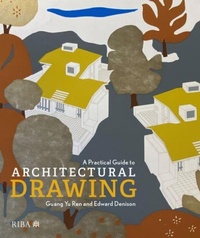
A Practical Guide to Architectural Drawing
RIBA Collections
1st Edition
Published on 1. September 2024
Book
Paperback/Softback
244 pages
978-1-914124-64-8 (ISBN)
Description
A visually stunning guide to architectural drawing from the RIBA Collections for students and those wanting to understand how to develop their graphic and representation skills.
Illustrated exclusively with drawings from the world's largest and most prestigious architectural drawing collection, it features an international span of works ranging from the Palazzo Porto Festa by Andrea Palladio to the Viceroy's House in New Delhi by Edwin Lutyens; from the illustration of Altun Kupri, Iraq, by Charles Felix Marie Texier to a coastal housing scheme by Balkrishna Vithaldas Doshi. The book delves into the reasons behind why we draw and the various methods used, covering the entire design process - from nurturing the earliest ideas to aiding construction, as well as surveying, recording, communicating, and representing architecture in spatial, structural, and material terms.
Focusing primarily on drawing techniques, it showcases a rich variety of different graphic styles, types, and modes of representation, presented thematically, offering a comprehensive overview.
This primer elevates the acquisition of practical drawing skills into a pleasurable experience, acquainting students with some of the most exquisite and accomplished graphic representations in the world.
Illustrated exclusively with drawings from the world's largest and most prestigious architectural drawing collection, it features an international span of works ranging from the Palazzo Porto Festa by Andrea Palladio to the Viceroy's House in New Delhi by Edwin Lutyens; from the illustration of Altun Kupri, Iraq, by Charles Felix Marie Texier to a coastal housing scheme by Balkrishna Vithaldas Doshi. The book delves into the reasons behind why we draw and the various methods used, covering the entire design process - from nurturing the earliest ideas to aiding construction, as well as surveying, recording, communicating, and representing architecture in spatial, structural, and material terms.
Focusing primarily on drawing techniques, it showcases a rich variety of different graphic styles, types, and modes of representation, presented thematically, offering a comprehensive overview.
This primer elevates the acquisition of practical drawing skills into a pleasurable experience, acquainting students with some of the most exquisite and accomplished graphic representations in the world.
More details
Language
English
Place of publication
London
United Kingdom
Target group
College/higher education
Professional and scholarly
Professional Practice & Development
Dimensions
Height: 250 mm
Width: 215 mm
Thickness: 16 mm
Weight
920 gr
ISBN-13
978-1-914124-64-8 (9781914124648)
Copyright in bibliographic data and cover images is held by Nielsen Book Services Limited or by the publishers or by their respective licensors: all rights reserved.
Schweitzer Classification
Other editions
Additional editions
E-Book
10/2024
1st Edition
RIBA Publishing
€45.99
Available for download
E-Book
10/2024
1st Edition
RIBA Publishing
€45.99
Available for download
Persons
Guang Yu Ren is an architectural researcher and tutor at The Bartlett School of Architecture (BSA, UCL) on undergraduate and postgraduate programmes.
Edward Denison is an architectural historian and Associate Professor at the Bartlett School of Architecture (BSA, UCL) where he is Director of the MA Architecture and Historic Urban Environments, Co-Coordinator of the Year 5 thesis module for MArch Architecture programme, module coordinator on the MA Architectural History and PhD supervisor.
Edward Denison is an architectural historian and Associate Professor at the Bartlett School of Architecture (BSA, UCL) where he is Director of the MA Architecture and Historic Urban Environments, Co-Coordinator of the Year 5 thesis module for MArch Architecture programme, module coordinator on the MA Architectural History and PhD supervisor.
Content
Foreword
Introduction
Chapter 1 Historical Summary
Chapter 2 Why we draw
Chapter 3 How we draw
Index Image credits
Introduction
Chapter 1 Historical Summary
Chapter 2 Why we draw
Chapter 3 How we draw
Index Image credits