

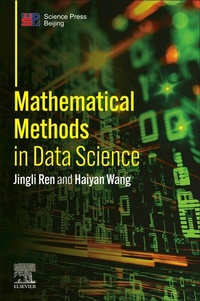
Mathematical Methods in Data Science
Published on 11. January 2023
Book
Paperback/Softback
258 pages
978-0-443-18679-0 (ISBN)
Description
Mathematical Methods in Data Science covers a broad range of mathematical tools used in data science, including calculus, linear algebra, optimization, network analysis, probability and differential equations. Based on the authors' recently published and previously unpublished results, this book introduces a new approach based on network analysis to integrate big data into the framework of ordinary and partial differential equations for data
analysis and prediction. With data science being used in virtually every aspect of our society, the book includes examples and problems arising in data science and the clear explanation of advanced mathematical concepts, especially data-driven differential equations, making it accessible to researchers and graduate students in mathematics and data science.
analysis and prediction. With data science being used in virtually every aspect of our society, the book includes examples and problems arising in data science and the clear explanation of advanced mathematical concepts, especially data-driven differential equations, making it accessible to researchers and graduate students in mathematics and data science.
Reviews / Votes
"This book is an interesting introduction to mathematical methods for data science. It covers ordinary differential equations and partial differential equations, and this is a main feature that distinguishes the book from others. The first chapters start gently to build some mathematical background on linear algebra, probability, calculus, and optimization. In the fourth chapter, the book presents real-world use of these mathematical tools for network analysis. Then the book goes deeper into the subject and discusses the methodologies of ordinary differential equations and partial differential equations, as well as their applications. Overall, the book is suitable for advanced undergraduate and beginning graduate students interested in mathematical data science methods." --Liangzu Peng, zbMATHOpenMore details
Language
English
Place of publication
Philadelphia
United States
Target group
Professional and scholarly
Product notice
Paperback (trade)
Dimensions
Height: 230 mm
Width: 153 mm
Thickness: 20 mm
Weight
421 gr
ISBN-13
978-0-443-18679-0 (9780443186790)
Copyright in bibliographic data and cover images is held by Nielsen Book Services Limited or by the publishers or by their respective licensors: all rights reserved.
Schweitzer Classification
Other editions
Additional editions
Jingli Ren | Haiyan Wang
Mathematical Methods in Data Science
E-Book
01/2023
Elsevier
€175.00
Available for download
Persons
She received the Ph.D. degree in applied mathematics from Beijing Institute of Technology, Beijing, China, in 2004. Her research interests include data science, applied mathematics, and applied statistics. She conducted five Projects of National Nature Science Foundation of China, one Alexander von Humboldt Fellowship for Experienced Researcher, and five Provincial Projects. She has published numerous articles in scholarly journals, such as Acta Mater.?Appl. Phys. Lett.?IEEE Trans. SMC?Infor. Sci.?J. Stat. Phys.?J. Nonlinear Sci.? Phys. Rev. B?Phys. Rev. E?Sci. China Math.?Sci. China Phys. and Sci. China Mater., etc. He completed his doctorate in mathematics, while also earning a master's degree in computer science at Michigan State University in 1997. He worked as a full-time software engineer in industry for almost ten years before joining Arizona State University. Dr. Wang's research interests include applied mathematics, data science, differential equations, online social networks. He has published numerous articles in scholarly journals and a book entitled, "Modeling Information Diffusion in Online Social Networks with Partial Differential Equations?, Springer, 2020. Recently he developed and taught a course, Mathematical Methods in Data Science, at Arizona State University.
Content
1. Linear Algebra
2. Probability
3. Calculus and Optimization
4. Network Analysis
5. Ordinary Differential Equations
6. Partial Differential Equations
2. Probability
3. Calculus and Optimization
4. Network Analysis
5. Ordinary Differential Equations
6. Partial Differential Equations