

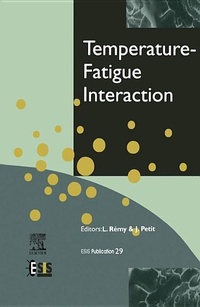
Temperature-Fatigue Interaction: Volume 29
Volume 29
Published on 11. March 2002
Book
Hardback
396 pages
978-0-08-043982-2 (ISBN)
Description
This volume contains a selection of peer-reviewed papers presented at the International Conference on Temperature-Fatigue Interaction, held in Paris, May 29-31, 2001, organised by the Fatigue Committee of the Societe Francaise de Metallurgie et de Materiaux (SF2M), under the auspices of the European Structural Integrity Society.
The conference disseminated recent research results and promoting the interaction and collaboration amongst materials scientists, mechanical engineers and design engineers.
Many engineering components and structures used in the automotive, aerospace, power generation and many other industries experience cyclic mechanical loads at high temperature or temperature transients causing thermally induced stresses. The increase of operating temperature and thermal mechanical loading trigger the interaction with time-dependent phenomena such as creep and environmental effects (oxidation, corrosion).
A large number of metallic materials were investigated including aluminium alloys for the automotive industry, steels and cast iron for the automotive industry and materials forming, stainless steels for power plants, titanium, composites, intermetallic alloys and nickel base superalloys for aircraft industry, polymers.
Important progress was observed in testing practice for high temperature behaviour, including environment and thermo-mechanical loading as well as in observation techniques.
A large problem which was emphasized is to know precisely service loading cycles under non-isothermal conditions. This was considered critical for numerous thermal fatigue problems discussed in this conference.
The conference disseminated recent research results and promoting the interaction and collaboration amongst materials scientists, mechanical engineers and design engineers.
Many engineering components and structures used in the automotive, aerospace, power generation and many other industries experience cyclic mechanical loads at high temperature or temperature transients causing thermally induced stresses. The increase of operating temperature and thermal mechanical loading trigger the interaction with time-dependent phenomena such as creep and environmental effects (oxidation, corrosion).
A large number of metallic materials were investigated including aluminium alloys for the automotive industry, steels and cast iron for the automotive industry and materials forming, stainless steels for power plants, titanium, composites, intermetallic alloys and nickel base superalloys for aircraft industry, polymers.
Important progress was observed in testing practice for high temperature behaviour, including environment and thermo-mechanical loading as well as in observation techniques.
A large problem which was emphasized is to know precisely service loading cycles under non-isothermal conditions. This was considered critical for numerous thermal fatigue problems discussed in this conference.
More details
Series
Language
English
Place of publication
Oxford
United Kingdom
Publishing group
Elsevier Science & Technology
Target group
Professional and scholarly
Product notice
sewn/stitched
Cloth over boards
Dimensions
Height: 236 mm
Width: 154 mm
Thickness: 24 mm
Weight
816 gr
ISBN-13
978-0-08-043982-2 (9780080439822)
Copyright in bibliographic data and cover images is held by Nielsen Book Services Limited or by the publishers or by their respective licensors: all rights reserved.
Schweitzer Classification
Other editions
Additional editions
L. Remy | J. Petit
Temperature-Fatigue Interaction
E-Book
03/2002
Elsevier
€175.00
Available for download
Persons
Content
Thermomechancial behaviour
Damage under isothermal loading
Damage under thermal-mechanical loading
Crack growth
Design and structures
Damage under isothermal loading
Damage under thermal-mechanical loading
Crack growth
Design and structures